Middletown's #1 Tree Expert Company
FREE Inspection & Estimate | Certified Arborists | Trimming, Pruning, Removal, More!
Sponsored
Leaf Balls Up in the Bare Branches
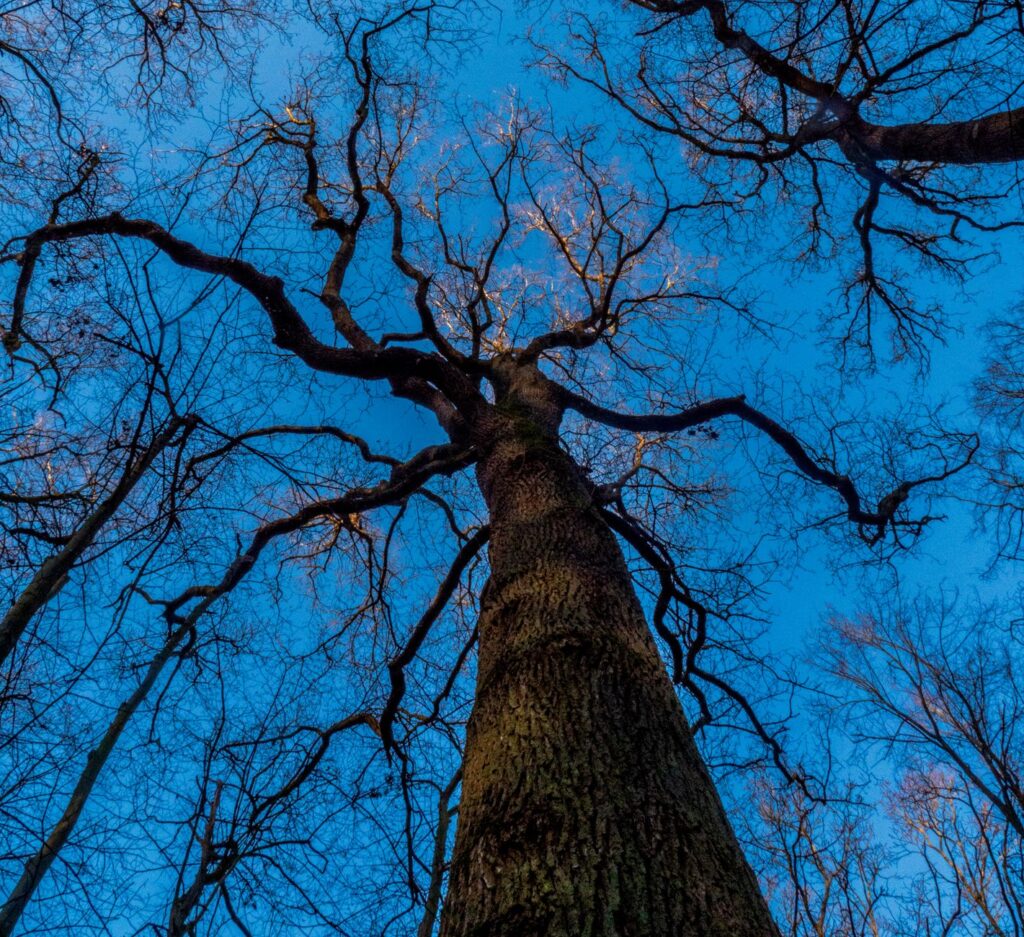
Once the maples and oaks along Middletown’s streets drop their leaves, a part of the neighborhood that was hidden all summer comes into view. High in the crowns you can suddenly see rough, round bundles of leaves and sticks wedged into the forks of the branches. Most people glance up, wonder whether something is wrong with the tree, and move on. These bundles are almost always squirrel nests, and they have been there since the warm months, tucked behind the foliage.
The eastern gray squirrel is the animal behind most of them. Its home range can be anywhere from one acre to a hundred, depending on how much food is available, and a tree-lined Bayshore street full of oaks, hickories and beeches offers a very good supply. If you live near Hartshorne Woods, Poricy Park or any of the older neighborhoods of Navesink and Lincroft, you probably have several nests within sight of your yard right now.
The useful question for a homeowner is not whether squirrels live in your trees. They do. It is whether what they are doing is harming the tree, and in the large majority of yards the honest answer is no. This article walks through how to read what you are seeing overhead, which squirrel and bird behavior is harmless, and the few signs that deserve a closer look.
How to Tell a Nest From a Problem
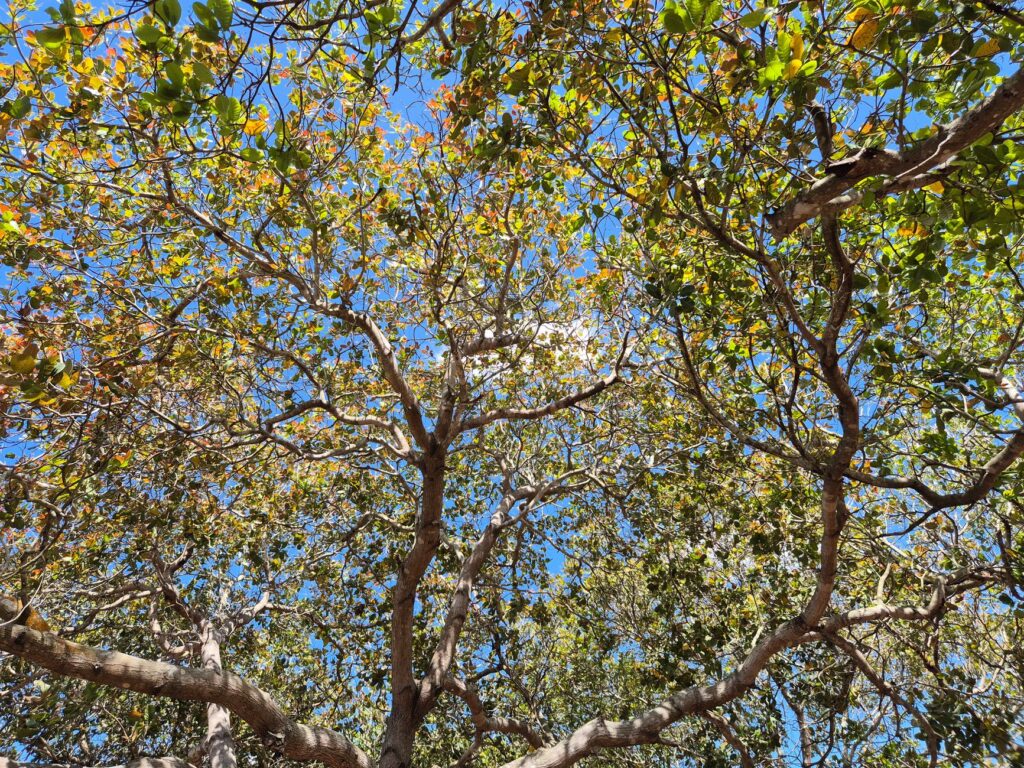
A squirrel’s leaf nest, sometimes called a drey, is a loose ball roughly the size of a basketball. It is built from sticks, leaves and stripped bark and is usually placed high in the tree, often where a major limb meets the trunk. The University of Maryland Extension describes exactly this construction and notes that nests are usually built high in the treetop. A nest in itself does not damage a healthy limb. The weight is small and the branch fork it sits in is usually among the strongest parts of the crown.
It is worth separating a nest from other things that look similar from the ground:
- Leaf clusters that never dropped. Some trees, such as young oaks and beeches, hold dead leaves through winter. These hang evenly along the twigs rather than gathering in one dense ball.
- Witches’ broom. A dense knot of twigs growing from one point on a branch is a growth abnormality. It stays twiggy and has no loose leaves woven into it.
- Vines. A tangle of dead vine in the crown can mimic a nest, but you can usually trace it down to the trunk.
- Hawk or crow nests. These are neat platforms of sticks with no leaves woven in, and they are built in the crowns of tall trees.
If you are unsure, a pair of binoculars on a clear afternoon settles it quickly. A leaf ball that stays put through wind and snow is a nest. The thing to watch is not the nest but the condition of the branch beneath and around it, which is where a different story sometimes starts.
Twig Clipping and the Litter Under Your Tree
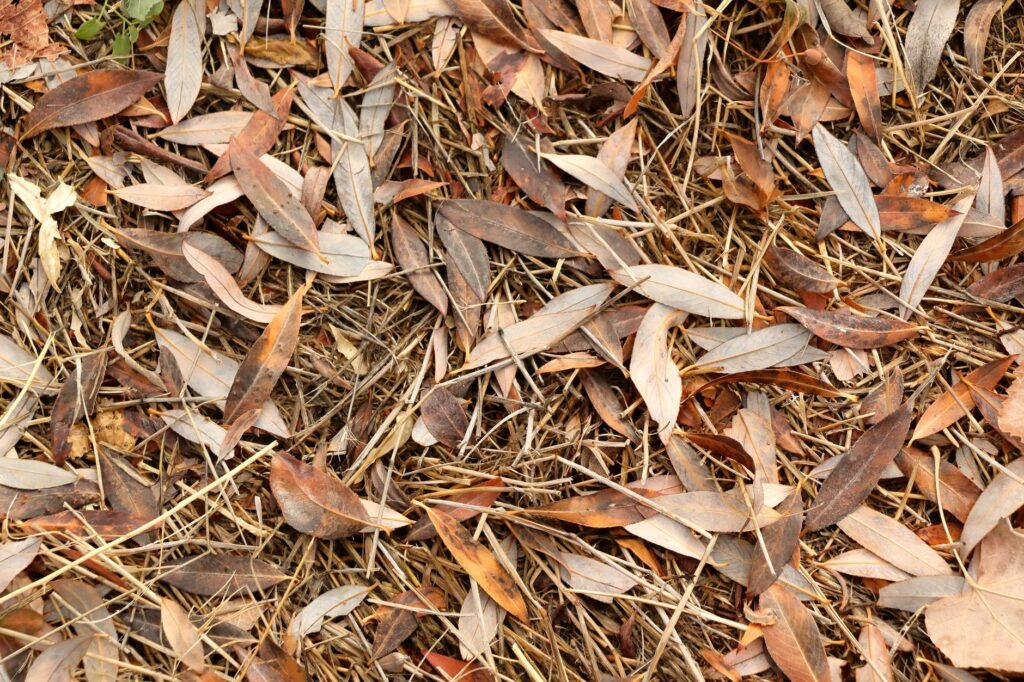
Squirrels also cut small twigs and branch tips as they build and repair nests, and they drop them as they go. If you find a scattering of leafy shoots, sometimes a foot or two long, on the lawn under an oak, maple or pine, that is the likely source. Kansas State University Extension’s squirrel damage guide treats this clipping as mostly a nuisance to the homeowner rather than a threat to the tree.
Clipping looks dramatic because the cut shoots still carry green leaves, but the tree loses only a tiny fraction of its foliage. Healthy trees lose far more to an ordinary windy afternoon. The University of Maryland guidance says the same: this behavior seldom damages the tree and little control is needed. In other words, there is nothing to spray, wrap or prune in response.
Look at the cut ends before you decide. A clean angled cut on a thin, leafy twig points to a squirrel. A ragged break on a much larger limb points to wind, ice or a structural defect, and that is a different conversation, one for the dead-limb checks you should do each fall anyway. Take a few photos of what you find and where, because a dated record of the condition of your trees is useful if a branch later fails.
Middletown's #1 Tree Expert Company
FREE Inspection & Estimate | Certified Arborists | Trimming, Pruning, Removal, More!
Sponsored
When Squirrels Strip Bark
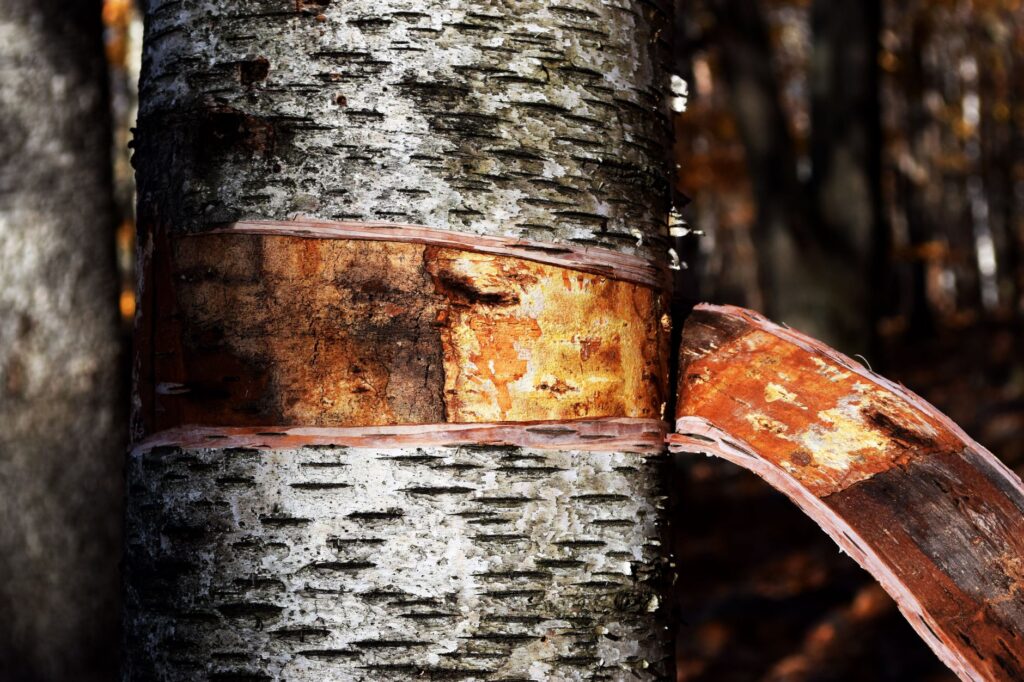
The one squirrel behavior that can hurt a tree is bark stripping. When food is scarce, squirrels sometimes gnaw the bark from branches and from the trunks of young trees to reach the tissue underneath. Kansas State’s guide warns that if the bark is removed all the way around a branch, that branch will die, because the tree’s food-carrying layer is cut. The Alabama Cooperative Extension System makes the same point about gnawing around the base of young trees in its guide to controlling gray squirrel damage.
For a Middletown homeowner the practical signs are these:
- Bark missing in patches on thin branches, with pale wood showing and gnaw marks you can feel with a fingertip.
- Damage concentrated on young trees, small ornamentals and the thin upper limbs of maples.
- Wounds that wrap most or all of the way around a stem, which are the ones that matter.
- Fresh damage that appears in winter or early spring, when natural food is at its lowest.
Extension sources also point out that heavy damage may really be deer or rabbits, so check the height of the wounds. Deer rub and browse sit within a few feet of the ground, and rabbits chew low on stems near the snow line. Squirrel damage tends to be higher and on thinner wood. A partial wound on a larger branch will usually seal over in time. A tree girdled on the main trunk is the case to take seriously.
Woodpeckers, Sapsuckers and the Holes in the Trunk
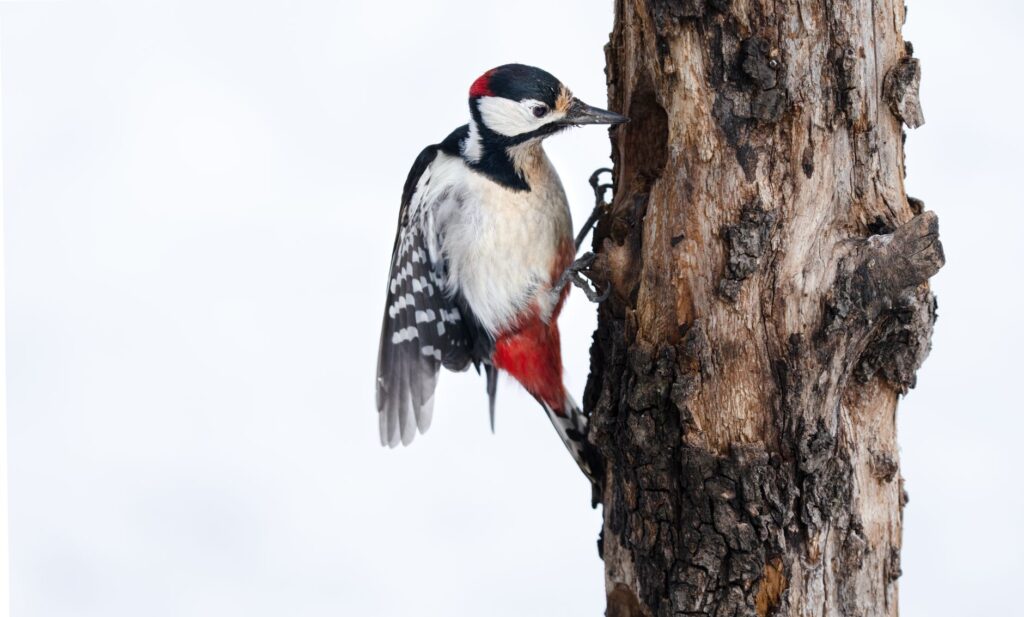
Bare branches also make another kind of animal activity easier to spot: holes. A woodpecker working on a trunk is one of the most common reasons homeowners worry about a tree, and the first instinct is to assume the bird found an infestation. Sometimes it did. More often it did not, and the pattern of the holes tells you which.
Neat, evenly spaced rows of small holes running around a trunk are usually the work of a sapsucker, a woodpecker that drinks sap rather than hunting insects. Sapsuckers pass through New Jersey in fall and winter, and they return to favorite trees. The wounds look alarming, but most healthy trees tolerate them. Larger, deeper excavations point to a bird chasing carpenter ants or beetle larvae in the wood, and that deserves more attention, because insects tend to work in wood that is already declining. Animals are often early warning signs, and this is one reason the International Society of Arboriculture’s Trees Are Good pages on trees and wildlife encourage owners to think about animals and tree health together.
If a single tree gets repeated heavy woodpecker work, with fresh wood chips at the base, thinning leaves in summer or dead branches in the crown, treat it as a health question rather than a wildlife question. A visit from a certified arborist can tell you whether the birds are chasing a defect or just feeding at a healthy tree.
What You Can Safely Do This Winter
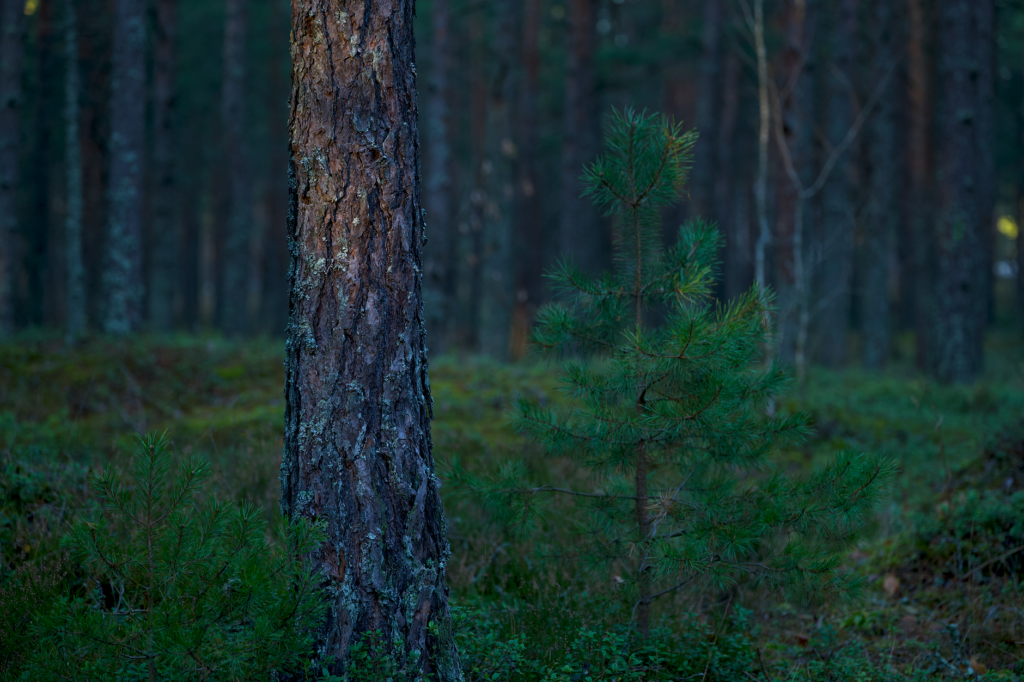
The good news is that most of the right response is to leave things alone. A tree that supports squirrels, nesting birds and winter foragers is part of the living neighborhood, and the New Jersey Division of Fish and Wildlife is a good place to learn what lives in your area and what rules apply to it before you do anything to the animals themselves. A few simple habits cover almost every situation:
- Leave healthy nests alone. Removing a leaf nest does nothing for the tree, and the animals will rebuild.
- Keep branches away from the house. Squirrels use overhanging limbs as a bridge to roofs and attics. A pruning cut on a limb that close to the roof should be made by a trained person, not from a ladder.
- Cut back the food. The Maryland and Alabama extension guides both recommend reducing food sources, including bird feeders, if squirrel pressure is a problem.
- Protect young trunks. A loose guard or a cylinder of hardware cloth, set a short distance from a new tree’s trunk, keeps gnawing off thin bark. Check it each season so it never tightens on a growing stem.
- Leave dead snags where they are safe. Dead wood that is nowhere near a house, driveway or play area gives woodpeckers and cavity nesters a home.
Check with the state before you trap, relocate or harm any wild animal. The rules differ by species and season, and extension guides themselves note that a permit may be needed. A phone call to Fish and Wildlife beats a costly mistake.
Middletown's #1 Tree Expert Company
FREE Inspection & Estimate | Certified Arborists | Trimming, Pruning, Removal, More!
Sponsored
When to Call a Certified Arborist

Most of what you see overhead in November is normal. Calling a certified arborist makes sense when the evidence points to the tree and not the animal. Consider a professional look if you notice any of the following:
- A squirrel nest in a limb that is cracked, hollow, dead or visibly leaning over a roof, driveway or play area.
- Bark stripped completely around a main trunk or a major scaffold limb.
- Heavy, repeated woodpecker work on one tree, especially with declining foliage the previous summer.
- Gnawing or den holes in a limb that already looks weak at its union with the trunk.
- Large clipped or broken limbs that do not match the thin squirrel cuts described above.
Each of these is really a question about the structure and health of the tree, with the animal as a symptom. A certified arborist can climb or use binoculars and a mallet to sound a suspect limb, read the wound, and tell you whether to wait, prune, protect or remove. Look for an ISA Certified Arborist credential, ask for the person’s number, and confirm it on the ISA site before hiring anyone.
Otherwise, enjoy the view. The leaf balls you can finally see in the bare crown mean your trees are doing what trees in a healthy suburb are supposed to do: feeding and sheltering a lot more life than you ever noticed in July.
Photo credits: Featured image by Mohan Nannapaneni on Pexels; Section 1 by L&Co N’gatsé on Pexels; Section 2 by Lan Nguyen Tran on Pexels; Section 3 by Mustafa Akın on Pexels; Section 4 by Robert Schrader on Pexels; Section 5 by Mirco Violent blur on Pexels; Section 6 by Lauri Poldre on Pexels; Section 7 by Laker on Pexels.