
Middletown's #1 Tree Expert Company
FREE Inspection & Estimate | Certified Arborists | Trimming, Pruning, Removal, More!
Sponsored
The Maple That Looked Fine Until It Didn't

The homeowner called me in early May, worried about the red maple in her front yard off Oak Hill Road in Lincroft. It had been planted about twelve years ago — a well-chosen spot, decent sun, the kind of tree every Middletown neighborhood seems to have. But the canopy this spring was noticeably sparse. The leaves that did open were smaller than she remembered, and a strip of bark on one side of the trunk looked faintly sunken. She’d already blamed last winter’s cold, blamed the dry stretch in April, blamed almost everything except the most likely culprit: a root that had been circling the base of that tree for over a decade and was now quietly choking it to death.
Girdling roots — sometimes called stem-girdling roots — are one of the most common and least-noticed causes of slow tree decline in Middletown neighborhoods. They form when a root grows parallel to or around the trunk rather than outward into the soil. Over years, as both the trunk and the offending root thicken, the root constricts the flow of water and nutrients through the bark. The tree starves in place, looking progressively worse each spring, until a storm or secondary disease finishes it off.
What makes this especially frustrating is that girdling roots are almost always a consequence of how a tree was planted, not bad luck or bad weather. Understanding the problem is the first step toward preventing it — or catching it early enough to do something about it.
What Are Girdling Roots and How Do They Form?

Under normal conditions, tree roots radiate outward from the trunk in all directions, anchoring the tree and drawing water and nutrients from the surrounding soil. The base of the trunk — the root collar, or root flare — sits at or just above the soil surface, allowing bark to breathe and the root system to develop freely.
Problems begin when that balance is disrupted at planting. The most common culprit is container-grown nursery stock. When a young tree sits in a round pot too long before sale, its roots hit the plastic wall and begin circling. If a nursery worker or landscaper doesn’t cut or tease out those circling roots before planting, they keep growing in their established pattern — not outward into new soil, but around the trunk. Over years, that circling root becomes a slowly tightening collar.
The second major cause is planting too deep. When soil or mulch buries the root collar, roots that emerge from the lower trunk get redirected — growing upward and then back toward the trunk rather than spreading naturally. This is often compounded by over-mulching, where years of piled-up mulch against the trunk re-creates the buried-collar conditions that encourage girdling season after season.
According to Rutgers NJAES Extension guidance on tree establishment, proper planting depth — with the root flare visible at or just above grade — is one of the single most critical factors in long-term tree survival. When that standard isn’t met, the conditions for girdling are set from day one.
Why May Is When the Symptoms Show Up

May in Middletown is when leaf-out makes invisible problems visible. A tree that looked acceptable all winter — a dormant tangle of branches — suddenly betrays itself when foliage develops, or fails to develop as fully as it should.
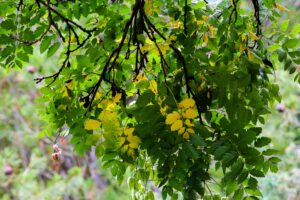
The signature symptoms of a girdling root problem at leaf-out include a noticeably thinner canopy, often worse on one side of the tree than the other. Leaves may be smaller than normal — a detail easier to spot on a species you’ve watched for years, like a red maple in your front yard. Leaf color can be off: pale, yellowish, or simply dull. On maples especially, a branch or two turning early fall color in May or June — what I sometimes call premature autumn — is a reliable indicator of a structural problem at the root collar.
At the base of the tree, look for a subtle but telling sign: the trunk may appear straight rather than flaring naturally into the soil. A healthy tree should look like it’s widening at the base, the way a telephone pole widens into a concrete footing — but in the other direction, broad and tapering. A girdled tree often looks like a post driven straight into the ground, with no visible flare. In some cases you’ll notice a faint concave indentation on one side of the trunk near grade, where the girdling root below is pressing against it.
The International Society of Arboriculture’s TreesAreGood homeowner resources recommend examining the root collar of any tree showing decline symptoms — and May, when the tree has leafed out and symptoms are most readable, is exactly the right time to look.
Middletown's #1 Tree Expert Company
FREE Inspection & Estimate | Certified Arborists | Trimming, Pruning, Removal, More!
Sponsored
Which Middletown Trees Are Most at Risk?
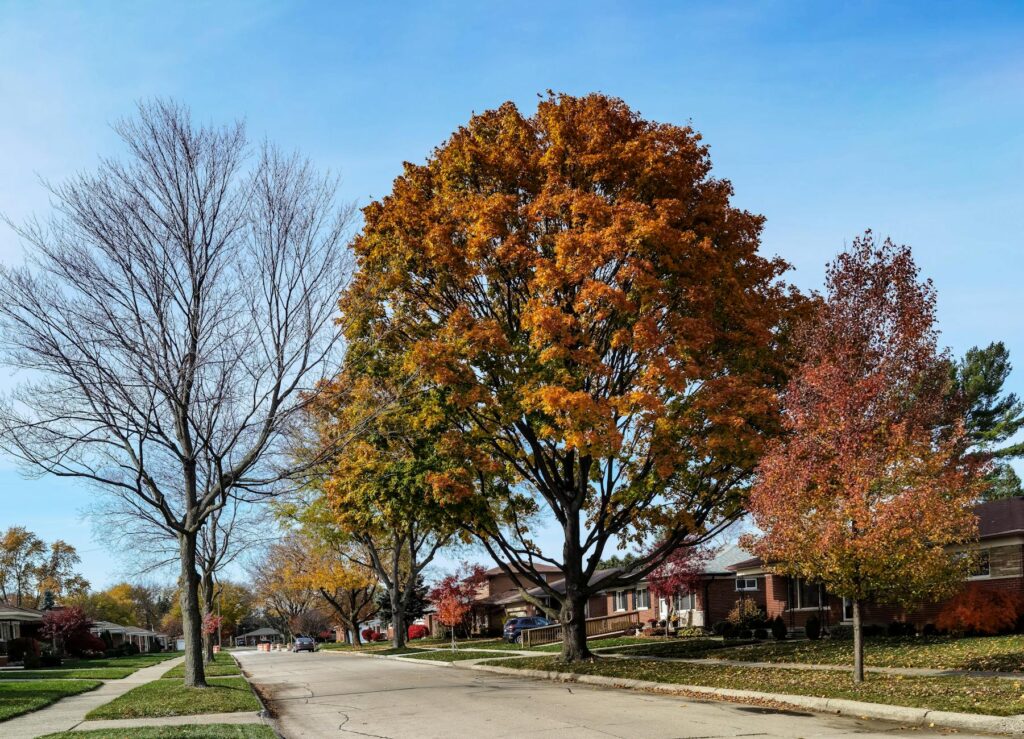
Girdling roots can form on almost any species, but certain trees planted widely across Middletown neighborhoods are especially prone to the problem, either because of their root biology or because they’re so commonly sold as container-grown nursery stock.
Red maple (Acer rubrum) and silver maple (Acer saccharinum) top the list. Maples are fast-growing with vigorous root systems, and they’re almost universally sold in containers. Their roots circle readily in pots, and they’re often planted in suboptimal conditions — clay-heavy fill soil that discourages outward root spread, or in sites where a landscaper’s crew buried the flare to make the tree sit at a convenient grade.
Pin oak (Quercus palustris) is another frequent victim. Widely planted as a street tree and in residential landscapes throughout Middletown, pin oaks adapt poorly to pot-bound conditions and develop girdling roots readily when containerized stock is planted without root correction. If you have a pin oak that’s been looking increasingly chlorotic — yellowing leaves — and you haven’t addressed iron availability in your soil, consider having the root collar checked before pursuing soil amendments.
Linden (Tilia species and cultivars), ornamental pears including the now-banned Bradford pear (Pyrus calleryana), and certain crabapple cultivars are also commonly affected. Street trees in Middletown face a compounded risk: confined planting pits, compacted subsoil, and limited root run that deflects roots back toward the trunk rather than outward. USDA Forest Service urban tree research documents how restricted rooting volumes common to street-tree sites significantly increase the likelihood of root deflection and girdling — a finding directly relevant to Middletown’s streetscapes along Route 35, Newman Springs Road, and surrounding residential blocks.
Diagnosing and Treating Girdling Roots

If you suspect a girdling root, the first step is a root collar examination. In many cases this begins by simply brushing away excess mulch and soil from the base of the tree by hand. If the trunk appears to drop straight into the ground with no visible flare, that’s already a signal worth investigating further.
A certified arborist trained in urban tree care can conduct a more thorough root collar excavation, either by hand or with an air spade — a tool that uses compressed air to move soil without cutting or damaging roots. This exposes the first several inches of the major lateral roots and reveals whether any are crossing or pressing against the trunk. In clear cases, the girdling root is obvious: a woody root visibly indenting one side of the bark. In subtler cases, it takes a trained eye and systematic probing.
Treatment depends on how long the problem has been developing. When caught early — before significant cambial damage has occurred — the offending root can often be cut flush and removed. Root collar excavation, removing the excess soil from around the trunk base, allows the root flare to breathe and the remaining root system to function more normally. Many trees stabilize meaningfully after this intervention.
For more advanced cases, the prognosis is guarded. If a girdling root has compressed the trunk for many years, the vascular tissue on that side may already be compromised beyond recovery. An arborist will assess the degree of cambial damage and give you an honest evaluation of whether treatment is worthwhile or whether the tree is too far gone to justify the investment. This is not a DIY project — improper cutting of major structural roots can destabilize a tree or accelerate its decline, and an air spade requires professional equipment and judgment to use correctly.
Getting It Right at Planting: Prevention From Day One
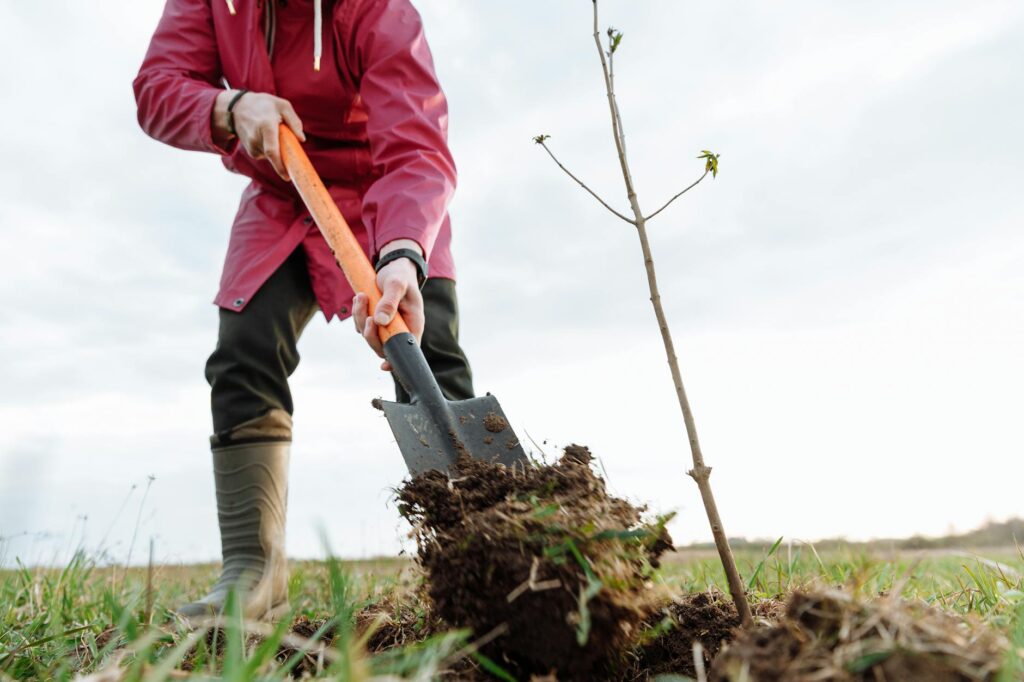
The best treatment for girdling roots is never creating the conditions for them in the first place. If you’re planting a new tree this May on your Middletown property — or planning one for fall — a few practices will determine whether that tree thrives for decades or quietly struggles and fails.
- Expose the root flare before planting. Whether you’re working with balled-and-burlapped or container stock, locate the root collar. Trees are often shipped with the flare buried under nursery soil or peat. Dig down through the root ball if necessary — plant the tree so that the flare sits at or just slightly above finished grade.
- Inspect and correct circling roots. With container stock, examine the outer edge of the root ball for woody roots that have begun circling the pot. Tease them outward into the planting hole, or — if they’re firmly established in a circular path — make clean cuts with a pruning saw before planting. This step takes five minutes and may add decades to the tree’s life.
- Dig wide, not deep. A planting hole two to three times the width of the root ball at the same depth as the ball allows roots to spread naturally rather than deflecting downward and back toward the trunk.
- Keep mulch away from the trunk. Apply a 3–4 inch layer of wood chip mulch over the root zone, but keep it pulled back 3–6 inches from the trunk at all times. No mulch volcanoes.
The NJ DEP Urban and Community Forestry program promotes proper tree planting practices throughout the state — exposing the root collar and avoiding deep planting are consistent recommendations across all of their educational materials. These aren’t optional refinements; they’re foundational to whether a landscape tree survives.
Middletown's #1 Tree Expert Company
FREE Inspection & Estimate | Certified Arborists | Trimming, Pruning, Removal, More!
Sponsored
Summary / When to Call a Pro
Girdling roots don’t announce themselves. They work slowly, over years, and a tree often looks subtly off for a long time before a homeowner realizes something is seriously wrong. By May, when Middletown’s trees are in full leaf and the contrast between a healthy canopy and a struggling one is most visible, it’s worth doing a quick check of any tree you’ve planted in the last ten to twenty years.
Look at the base of the trunk. Is there a visible root flare — a natural widening as the trunk meets the soil — or does it disappear straight into the ground? Is the canopy full and symmetrical, or thin and uneven? Does the bark look slightly sunken or compressed anywhere near grade? If the answer to any of those questions is yes, don’t wait another growing season to find out why.
A single consultation with an ISA-certified arborist can determine within an hour whether you have a girdling root issue, how severe it is, and whether treatment is worthwhile. Root collar excavation can sometimes add years of productive life to a tree that would otherwise fail in the next major storm. In other cases, the arborist may find the damage is too advanced and recommend removal before the tree fails structurally — which is a much safer and cheaper outcome than an emergency call after a windstorm drops a half-dead trunk across your roof.
Either way, knowing now is always better than discovering too late. The tree may have been strangling quietly for a decade, but that doesn’t mean there’s nothing left to do about it.
Photo credits: Featured image by Castorly Stock on Pexels; Section 1 by Alex Albert on Pexels; Section 2 by Barış Türköz on Pexels; Section 3 by Lana Kravchenko on Pexels; Section 4 by Sarowar Hussain on Pexels; Section 5 by Plato Terentev on Pexels; Section 6 by Thirdman on Pexels; Section 7 by Henk Schuurmans on Pexels.