
Middletown's #1 Tree Expert Company
FREE Inspection & Estimate | Certified Arborists | Trimming, Pruning, Removal, More!
Sponsored
Why That Oak Is Still Wearing Its Dead Leaves
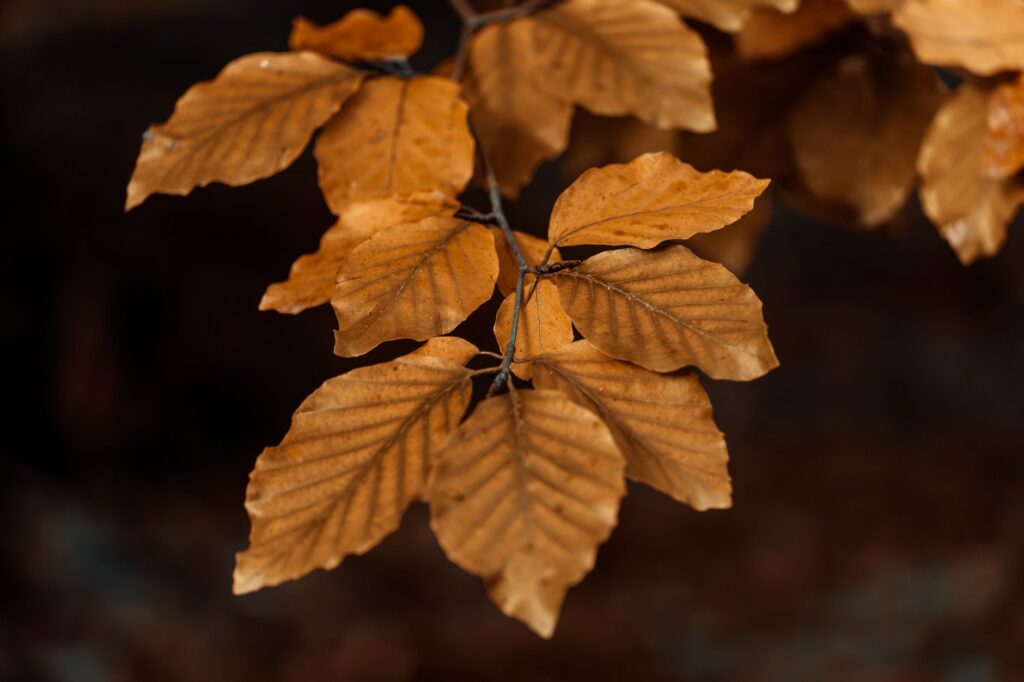
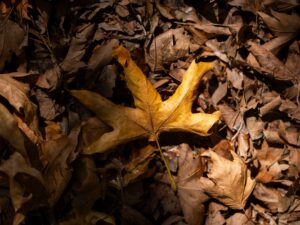
By mid-October the maples along Middletown’s side streets are already shedding, and a few weeks from now the ground under them will be a carpet. Walk into Hartshorne Woods Park in January, though, and you will notice something odd: certain trees are still holding crisp, tan leaves long after their neighbors went bare. Those trees are not sick, and they did not miss a memo. They are showing a trait called marcescence.
Marcescence simply means that a tree keeps its dead leaves through winter instead of dropping them in fall. In our part of Monmouth County, the usual suspects are young oaks, American beech (Fagus grandifolia), and the occasional hornbeam. Once you learn to spot it, you start seeing it everywhere, from the Navesink bluffs to the edge of a Lincroft cul-de-sac.
It is one of the more interesting quirks of tree biology, and it raises a fair question for any homeowner who owns one of these trees: is it normal, is it a warning sign, and is there anything worth doing about it?
How Trees Normally Let Go: The Abscission Layer
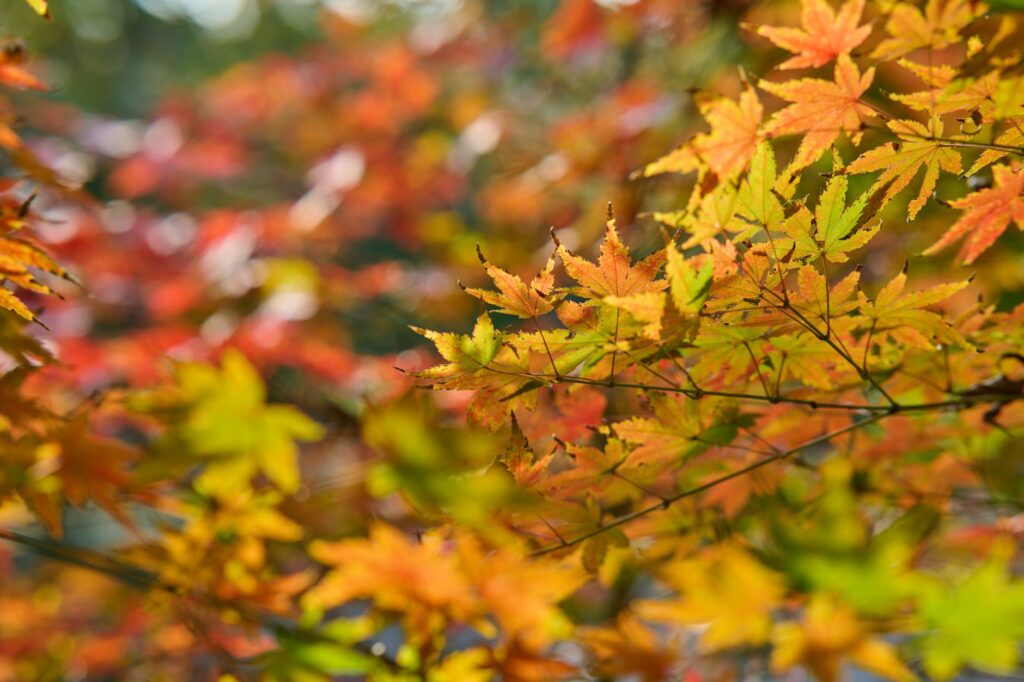
To understand why some trees hold on, it helps to know how most trees let go. As days shorten in late summer, a deciduous tree builds a thin band of corky cells at the base of each leaf stem. This is the abscission layer. It slowly seals off the leaf from the twig, stops the flow of water and sugars, and eventually weakens the connection until wind or gravity finishes the job.
The process is hormonally controlled, and it is the reason a healthy sugar maple can go from green to bare in a couple of weeks. The same shift in hormones that drives fall color drives leaf drop, and a clean break at the leaf base leaves a small scar the tree seals against decay and water loss.
The USDA Forest Service and university extension programs describe this as one of the tree’s major seasonal housekeeping tasks. It saves the tree from carrying thousands of thin, water-hungry leaves into a freezing season when it cannot photosynthesize anyway. Marcescent trees do a weaker version of this: the layer forms only partway, so the leaf dies but stays attached.
Which Middletown Trees Hold Their Leaves
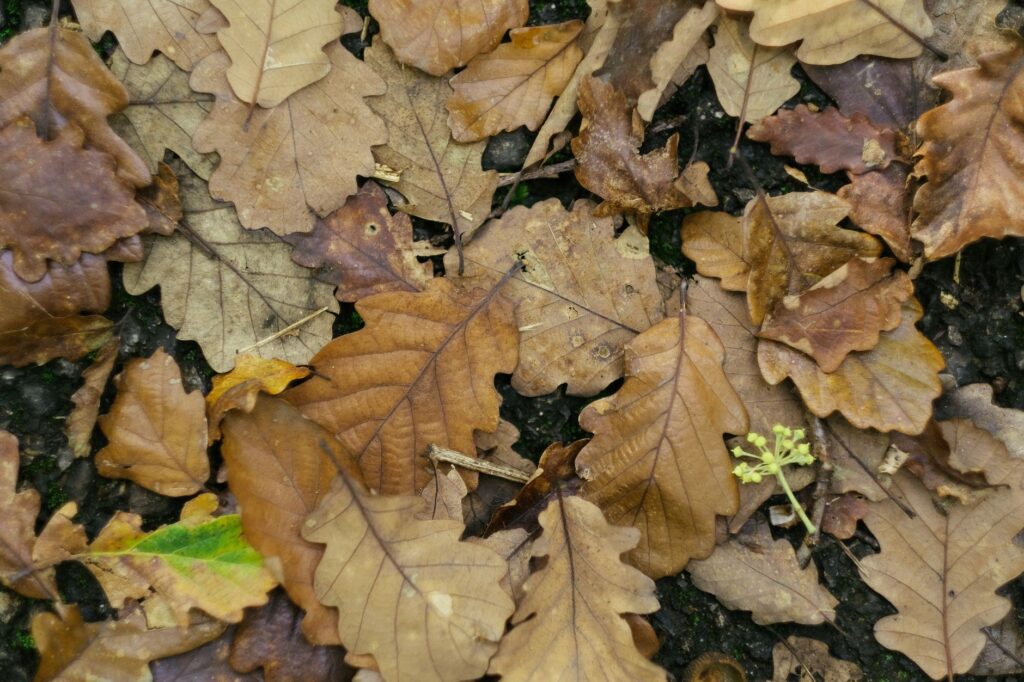
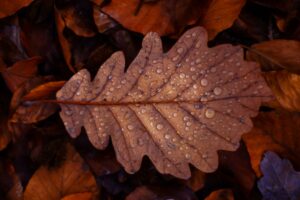
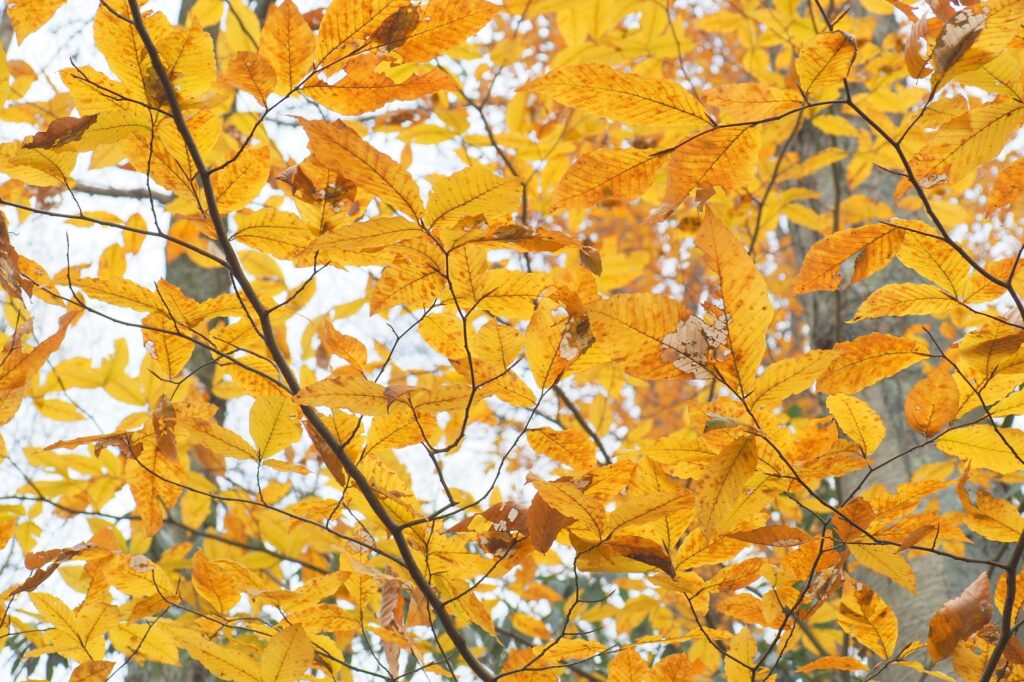
The most reliable marcescent tree in our area is American beech. Even mature beeches often keep a large share of their leaves into early spring, turning a pale parchment color that glows on gray winter afternoons. Young oaks follow close behind, especially white oak (Quercus alba), northern red oak (Quercus rubra), and scarlet oak (Quercus coccinea). Pin oak (Quercus palustris), common as a street tree around the Bayshore, is famous for it.
A useful pattern: the younger and lower the branch, the more likely the leaves stay. A twenty-year-old white oak may keep nearly every leaf on its lower limbs while the crown goes bare. An old oak, by contrast, may hold only a scattering near the bottom. Hedges of American hornbeam and some ornamental shrubs do the same thing.
- American beech: holds leaves on nearly all ages, often until bud swell.
- Oaks: strongest on saplings and the lower branches of mature trees.
- Pin oak: a street-tree classic, sometimes holding leaves into April.
- Hornbeam and witch hazel: partial retention, more variable.
If you are not sure what you own, winter is actually a fine time to find out. A tree that keeps its tan leaves is already giving you an identification clue.
Middletown's #1 Tree Expert Company
FREE Inspection & Estimate | Certified Arborists | Trimming, Pruning, Removal, More!
Sponsored
Why Would a Tree Do This? What Scientists Think

Honestly, nobody has a final answer, and researchers still debate it. Several explanations have decent support, and they are not mutually exclusive. One idea is that retained leaves protect tender buds from browsing deer. Dry, scratchy leaves around a twig make it a less appealing meal, which matters on a suburban lot where deer pressure is heavy.
A second idea is nutrient timing. Leaves that drop in spring, right as the soil warms and roots wake up, may deliver a nutrient-rich mulch exactly when the tree needs it most, rather than letting it wash away or break down during winter. This may help trees on thin, sandy or poor soils, which describes parts of the coastal plain.
A third idea involves snow and wind. Leaves that stay on a young tree can trap snow around the base, adding moisture, and may shelter the trunk from harsh wind. The Rutgers New Jersey Agricultural Experiment Station publishes seasonal plant guidance for the state, and its horticulture staff are a good starting point for questions about how local species behave through winter.
The honest summary is that marcescence looks like an evolutionary leftover that may still be paying small dividends. It is a feature, not a defect.
When Held Leaves Are a Problem, Not a Quirk
Most of the time, held leaves are harmless. There are cases where they deserve a closer look. The key is whether the whole tree is behaving the same way, or whether one tree stands out from its neighbors.
Here is the difference. A beech or a young oak keeping leaves on all its branches, with plump buds and normal twig growth, is normal. A maple, ash, or cherry that suddenly keeps shriveled leaves on one limb while the rest of the crown drops cleanly is not. That pattern usually means the limb died before the abscission layer could form, often from a canker, a girdling root, drought, or storm damage that cut off the water supply.
Dead leaves clinging to a single branch in November are a flag worth noting. Photograph the tree now, and look again in February once the other leaves are gone. A branch that stays dead and brown all the way into spring is probably a dead branch, and dead branches are a liability over driveways, play areas and rooflines.
- Check for leaves that are tightly curled and brown while neighbors are still green.
- Look for peeling bark, oozing sap, or fungal growth near the same limb.
- Note whether the problem sits on one side, which can point to root or trunk damage below.
Beech trees in particular deserve a close look this season, because beech leaf disease has reached New Jersey and can make leaves look leathery and dark-banded before they hang on.
What Homeowners Should Do With Marcescent Trees
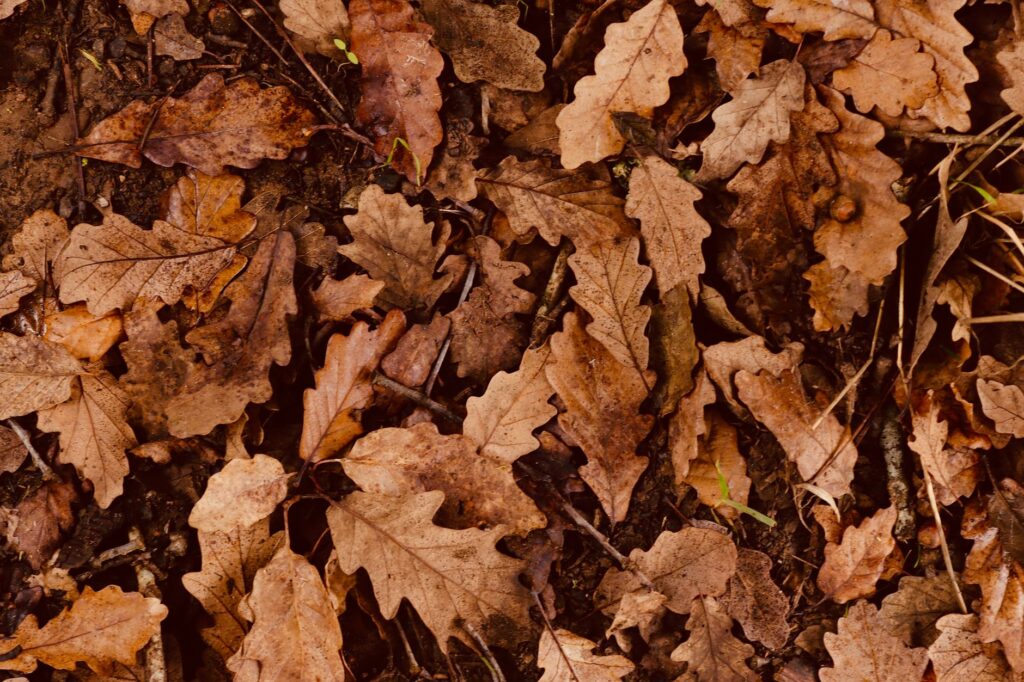
For a healthy marcescent tree, the answer is mostly nothing. Do not strip the leaves, shake the branches, or rake them off a hedge. Those leaves are doing a job, and pulling them can injure the twigs and buds that are quietly preparing for spring.
When the leaves finally drop in April, treat them like any other leaf litter. Let them stay under the tree where they break down and feed the soil, or lightly mulch them in place. A thin layer of shredded leaves is far better for roots than bare compacted lawn, and the Trees Are Good guidance from the International Society of Arboriculture supports leaving leaf litter where it falls whenever the site allows.
Winter is also the right time for a few simple observations. A bare tree shows its structure honestly, and a marcescent tree has an added advantage: you can compare which branches kept leaves and which did not. A branch that is bare while its neighbors hold leaves can be the first hint that something is wrong.
Finally, resist the urge to prune a marcescent tree just because it looks untidy in January. Most oaks are best pruned while dormant, but that is a decision for late winter, and it should follow the structure of the tree rather than its appearance.
Middletown's #1 Tree Expert Company
FREE Inspection & Estimate | Certified Arborists | Trimming, Pruning, Removal, More!
Sponsored
Summary: Reading the Winter Tree and When to Call a Pro
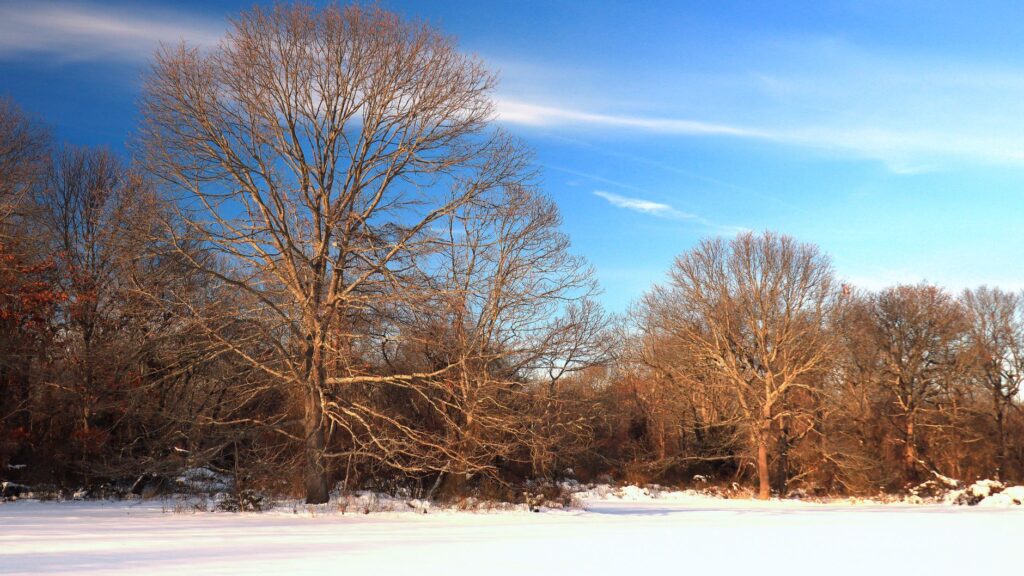
Marcescence is one of the quieter pieces of tree biology, and in Middletown it is easy to see once you know the clues. American beech, young oaks and pin oaks hold their dead leaves because of how their abscission layers form, and the tradeoffs appear to include bud protection and well-timed spring mulch. In most cases, it is normal and harmless.
What deserves attention is the exception: a tree or a single limb that holds dead leaves while its neighbors drop clean. That pattern, along with cankers, cracks, fungal growth or thin crowns, is worth a look from a professional. A certified arborist can tell the difference between a tree doing something odd and a tree in trouble, and can examine the roots, trunk and canopy together instead of guessing from the ground.
If you have a beech, a pin oak or a young white oak that keeps its leaves, take a photo in January and again in April. Those two images are a handy record for an arborist visit later, and the New Jersey Forest Service offers statewide resources on forest health that can help you place what you see in context. Winter is not a dead season for trees. It is a season of reading what they have been telling you all year.
Photo credits: Featured image by Gene Samit on Pexels; Section 1 by Aliaksei Semirski on Pexels; Section 2 by 开 心 on Pexels; Section 3 by Sami Aksu on Pexels; Section 4 by Aaron J Hill on Pexels; Section 5 by Maria Firman on Pexels; Section 6 by Leyla Dalkılıç on Pexels; Section 7 by John Foster Rossi on Pexels.