
Middletown's #1 Tree Expert Company
FREE Inspection & Estimate | Certified Arborists | Trimming, Pruning, Removal, More!
Sponsored
The Tree That Wasn't Leaning Yesterday
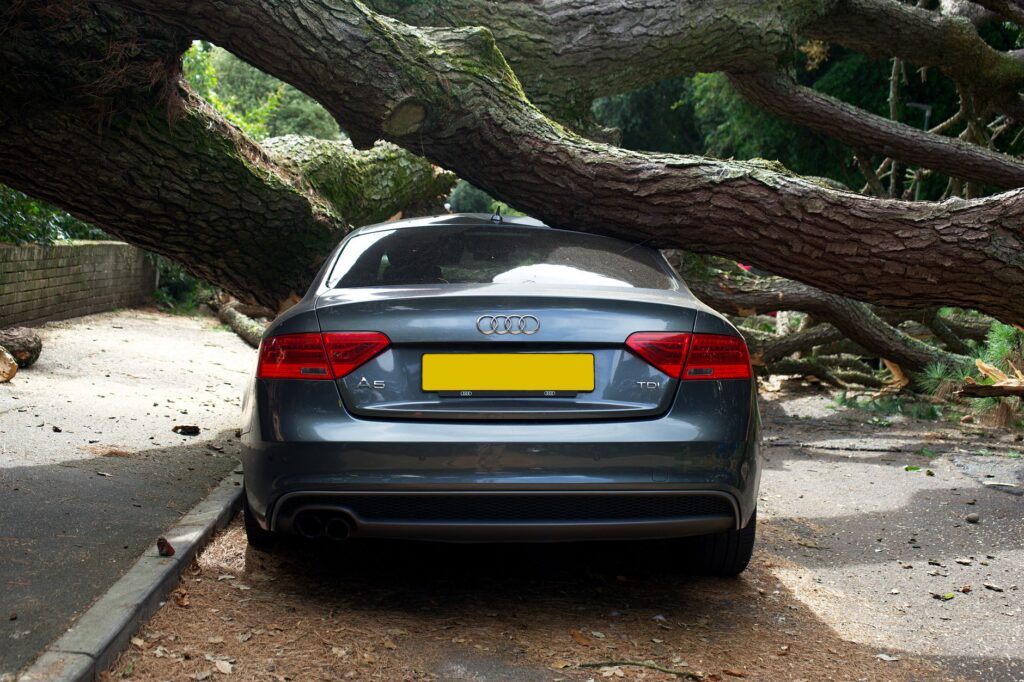
I got a call last week from a homeowner off Kanes Lane in Middletown who’d walked outside after a fast-moving July thunderstorm to find her silver maple leaning noticeably toward the driveway. Nothing had fallen. No branches were down. But the tree that had stood straight for thirty years now looked like it was reaching for her garage, and she wanted to know if she should be worried.
The honest answer is: it depends, and the difference matters. A tree that has always had a gentle lean — the kind that develops slowly over decades as it reaches for sunlight — is usually nothing to lose sleep over. A tree that leans overnight, especially after wind, heavy rain, or a saturated root zone, is a different animal entirely. That sudden shift often means the root plate itself has moved, and a moved root plate is one of the more reliable predictors of a tree that’s going to come down, sometimes with very little additional warning.
Summer storms along the Bayshore tend to arrive fast and hit hard — short, violent cells that dump an inch of rain in twenty minutes, followed by gusts that catch a fully leafed-out canopy like a sail. That combination is exactly what turns a healthy-looking tree into a leaning one almost overnight. Knowing how to read what you’re looking at is the difference between a phone call that can wait until Monday and one that needs to happen tonight.
Why Trees Lean: Slow Drift vs. Sudden Failure
Not all lean is created equal, and the timeline is the single most important clue. A tree growing at the edge of a wood line or beside a house often develops what arborists call phototropic lean — it bends gradually toward the strongest light source over years, and the trunk and root system adapt and strengthen right along with it. Walk your property and you’ll probably find a few trees like this. If the lean has been photographed in old family pictures looking the same as it does today, it’s structural, not an emergency.
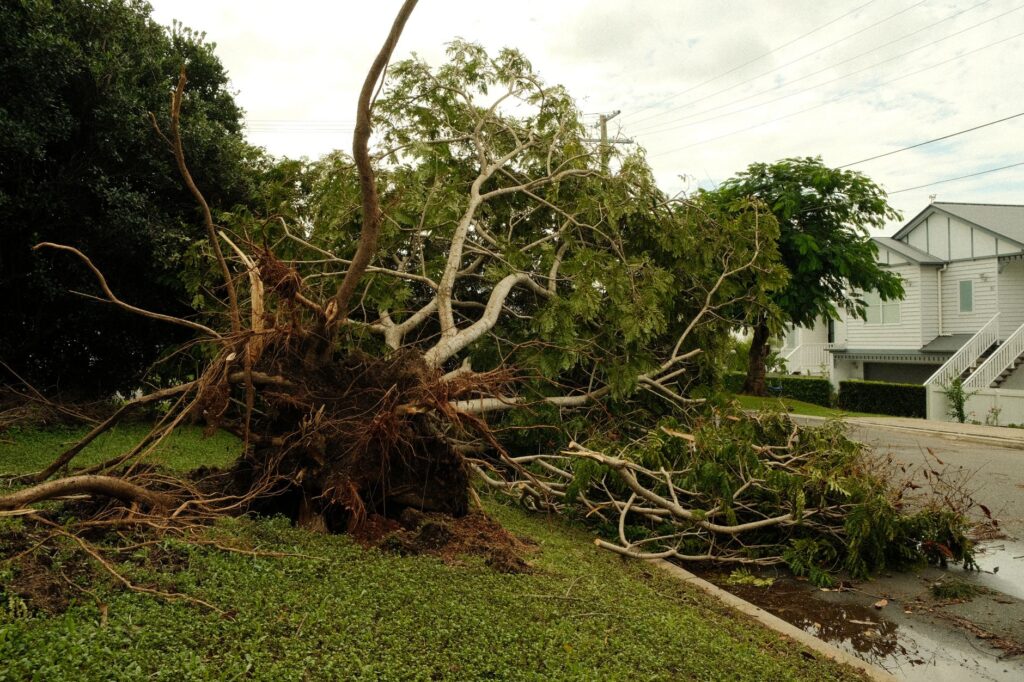
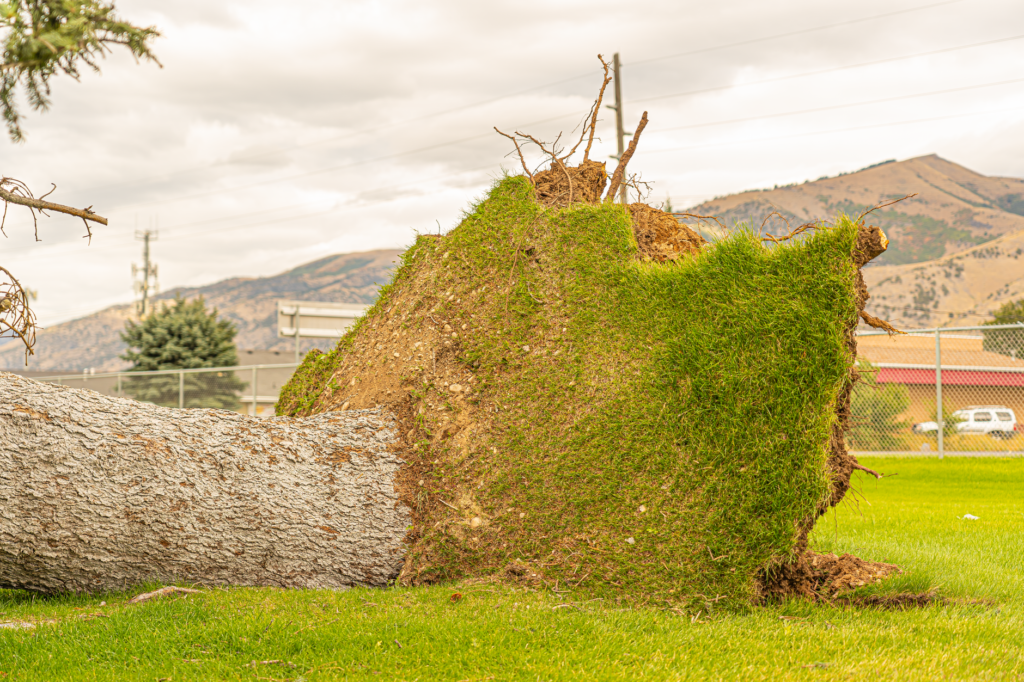
Sudden lean is a different mechanism altogether. It usually means the root plate — the disc of structural roots and soil that anchors the tree — has partially lifted or sheared, most often on the side opposite the direction of the lean. You’ll frequently see this after a period of heavy rain followed by wind, because saturated soil loses much of its shear strength right when wind load on the canopy peaks. According to the USDA Forest Service’s research on urban tree failure, root plate failure is among the most common causes of whole-tree failure in developed landscapes, and it disproportionately affects trees growing in compacted or poorly drained soils — a description that fits a lot of Middletown’s clay-loam yards after a wet week.
Species matters too. Shallow, wide-spreading root systems — common in silver maple, Norway maple, and many willows — tend to show root-plate movement more dramatically than deep-rooted species like white oak. Pin oaks planted in the heavier, wetter soils common near the Bayshore can also be prone to this after saturation, simply because wet clay holds roots less firmly than well-drained loam.
The Signs That Separate 'Watch It' From 'Call Tonight'

Before you do anything else, walk the full circumference of the base of the tree, not just the side you can see from the driveway. Here’s what actually tells you something:
- Soil heaving or cracking on the side opposite the lean — a ridge of lifted turf or a visible crack in the soil surface is the clearest sign the root plate has moved.
- Exposed or snapped roots at or near the base, particularly ones that look freshly torn rather than weathered.
- A lean that’s new — check old photos, ask a neighbor, or simply trust your own memory of walking past that tree daily.
- A lean paired with canopy dieback or existing decay — a tree that was already compromised structurally has far less reserve capacity to tolerate a root disturbance.
- Proximity to a target — a house, a driveway, a power line, a spot where kids play. The same lean is a curiosity in the back of a wooded lot and a genuine hazard six feet from a bedroom window.
If you see soil movement at the base combined with a lean that appeared within the last day or two, treat that as an emergency regardless of species or tree size. That combination is the textbook signature of a tree in the process of failing, not one that has already found a new equilibrium.
Middletown's #1 Tree Expert Company
FREE Inspection & Estimate | Certified Arborists | Trimming, Pruning, Removal, More!
Sponsored
What to Do in the First 24 Hours
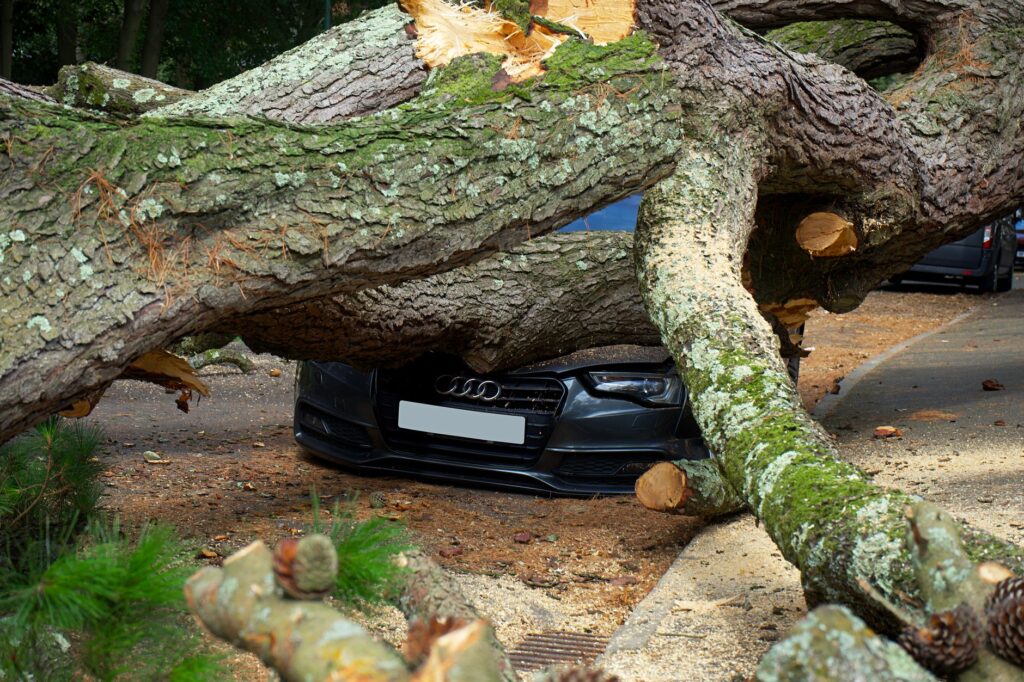
If you spot a newly leaning tree with signs of root movement, the first move isn’t to grab a comealong and try to straighten it — that’s appropriate for a young, recently planted tree with an intact root ball, not a mature specimen with a compromised root plate. Pulling on a large leaning tree, or worse, having someone climb it to assess the canopy, can be exactly the wrong move if the root system is already partially failed.
Instead:
- Keep people, pets, and vehicles out of the tree’s potential fall radius — figure roughly one and a half times the tree’s height as a rough buffer.
- Photograph the base from multiple angles, including any soil heaving or cracking, along with the overall lean. This documentation matters for insurance and gives an arborist useful information before they even arrive.
- Avoid parking cars or leaving equipment in the fall zone overnight.
- Call a certified arborist for an assessment rather than a general tree-cutting outfit — you want someone trained to evaluate root plate integrity, not just estimate a removal price.
If the lean is severe, growing worse by the hour, or directly threatening a structure, that’s a call to make immediately rather than waiting for morning. Most of the truly urgent situations I’ve been called out for started exactly this way — a homeowner noticed the change quickly and didn’t wait to see if it would resolve on its own.
What a Professional Risk Assessment Actually Checks

When an arborist shows up for a lean like this, the visual inspection is only part of it. A proper hazard assessment follows a structured process — the International Society of Arboriculture’s Tree Risk Assessment Qualification is the industry standard many certified arborists train under, and it evaluates the tree, the site, and the target together, not the tree in isolation.
In practice, that means checking soil moisture and drainage around the root zone, probing for cavities or decay at the root collar, measuring the degree of lean against any historical baseline, and evaluating what’s actually in the fall path. A tree with the exact same lean might get a completely different recommendation depending on whether it’s fifteen feet from a swing set or standing alone at the back of a two-acre lot. The Rutgers NJAES tree risk resources are a good starting point if you want to understand the assessment framework before an arborist arrives — it’ll help you ask better questions and understand the reasoning behind whatever recommendation you get.
Sometimes the outcome of that assessment is reassuring: cabling or bracing can stabilize a lean that’s structurally sound but cosmetically alarming. Other times, especially with confirmed root plate failure on a tree near a target, removal is the only responsible recommendation. Either way, you want that judgment coming from training and a documented process, not a guess made from the curb.
A Note on Permits and Neighbor Trees
If an assessment does point toward removal, keep in mind that Middletown Township has its own rules around tree removal depending on the property and tree size — it’s worth a quick check with Middletown Township’s municipal offices before work begins, particularly if the tree is large or near a protected area. And if the leaning tree in question is actually on a neighbor’s property but threatens yours, New Jersey’s approach to that situation is more nuanced than most homeowners expect — generally, you can trim what crosses onto your side, but addressing the tree itself, especially one showing active root failure, usually requires the neighbor’s cooperation or a documented safety concern shared with them directly and promptly.
Either way, don’t let a boundary-line question slow down the safety response. Document what you see, keep people clear of the fall zone, and have the conversation with your neighbor or the township in parallel with getting a professional opinion, not instead of it.
Middletown's #1 Tree Expert Company
FREE Inspection & Estimate | Certified Arborists | Trimming, Pruning, Removal, More!
Sponsored
When to Call a Pro — and When to Just Keep Watching
Most leaning trees in Middletown yards are not emergencies. A gentle, long-standing lean toward a light gap, unaccompanied by soil disturbance or canopy decline, is simply how that tree grew, and it can often be monitored rather than treated. If that describes what you’re looking at, a good habit is to photograph it once a season so you have a real record of whether the angle is changing over time.
But a sudden lean — one that showed up in the last day or two, especially following heavy rain and wind, and especially paired with heaved or cracked soil at the base — deserves a same-day call to a certified arborist, not a wait-and-see approach. The cost of an assessment is small compared to what a mature tree can do to a roof, a car, or a person if that root plate finishes what it started. If you’re ever unsure which category your tree falls into, that uncertainty itself is reason enough to get a trained set of eyes on it before the next storm rolls through.
Photo credits: Featured image by Mike Bird on Pexels; Section 1 by April Yang on Pexels; Section 2 by Castorly Stock on Pexels; Section 3 by Henrik Pfitzenmaier on Pexels; Section 4 by Mike Bird on Pexels; Section 5 by Gastón Mousist on Pexels; Section 6 by christianne on Pexels; Section 7 by Jenkin Shen on Pexels.