
Middletown's #1 Tree Expert Company
FREE Inspection & Estimate | Certified Arborists | Trimming, Pruning, Removal, More!
Sponsored
A White Woolly Warning in the Hemlock Canopy

Every April, after the last frost has loosened its grip on Middletown Township, I find myself doing the same thing: running my fingers along the underside of hemlock branches, checking for the telltale white fuzz that signals trouble. The eastern hemlock (Tsuga canadensis) is one of the most underappreciated trees in our region — dense, graceful, year-round green — and hemlock woolly adelgid (HWA) has been quietly killing them across Monmouth County for years.
If you have hemlocks on your property, or you walk the wooded trails at Hartshorne Woods Park or Poricy Park, now is the time to pay close attention. Spring is when the second generation of HWA crawlers becomes active on new growth, making this the most visible moment of the year to spot an infestation before it escalates. A hemlock that looks merely stressed today can be dead within a few seasons if HWA goes unchecked.
This article walks you through what HWA looks like, how to scout for it, what treatment options are available, and — critically — what mistakes to avoid. Hemlocks are worth saving, but the window to act is now.
What Is Hemlock Woolly Adelgid, and Where Did It Come From?
Hemlock woolly adelgid (Adelges tsugae) is a tiny aphid-like insect native to Japan. It arrived in the eastern United States near Richmond, Virginia, in the 1950s and has been moving north ever since. Unlike many invasive pests, HWA has no significant natural predators in North America capable of keeping pace with its reproduction rate. In New Jersey, it has now infested hemlock populations from the Kittatinny Mountains to the coastal plain — including right here in Monmouth County.
HWA completes two generations per year. The overwintering generation (called sistens) feeds through winter and lays eggs in early spring. The spring generation (progrediens) is active right now, in late April and May, feeding actively on new growth. Each female can produce up to 300 eggs. The insects spend most of their lives protected beneath the white woolly masses they secrete at the base of needles — masses that look harmless but represent continuous feeding that steadily drains the tree’s carbohydrate reserves.
You can read more about the pest’s biology and New Jersey-specific management history in Rutgers NJAES Fact Sheet FS751 on Hemlock Woolly Adelgid, the most thorough local guide available. The USDA Forest Service Pest Alert for HWA also provides a clear overview of how the pest moves and spreads across the landscape.
How to Scout Your Hemlocks This Week
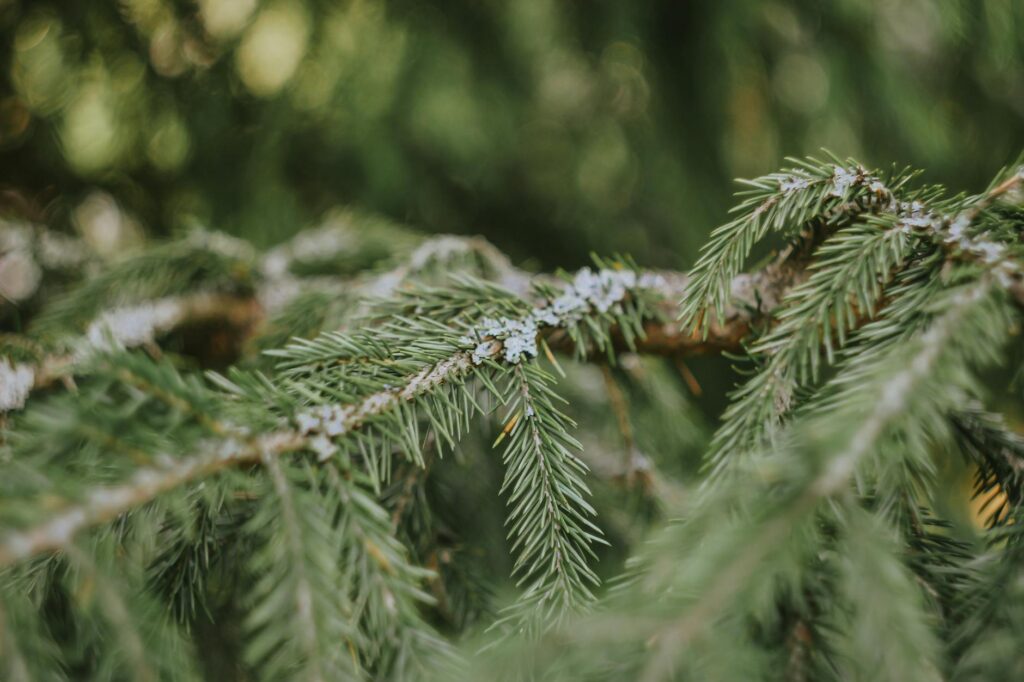
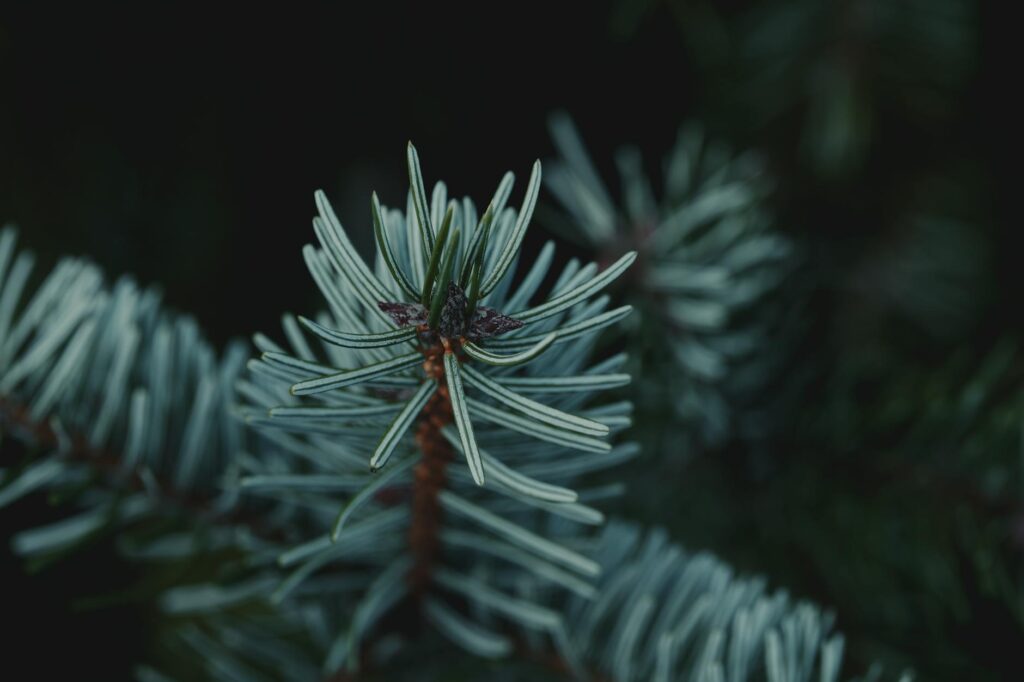
Scouting is straightforward and takes only a few minutes. Find a hemlock — most commonly used as privacy screening or a specimen tree in Middletown yards — and look at the underside of the branch tips. Healthy hemlocks have two rows of flat, dark-green needles with white stomatal bands visible underneath. If you see small white woolly masses at the base of individual needles, you have HWA.
Early infestation signs are subtle: needles may fade from deep green to a grayish or yellowish-green tone, and the tree may seem slightly less dense than in previous years. More advanced infestations cause premature needle drop, tip dieback that works inward from the branch ends, and eventually a stripped, gray skeleton where a lush tree used to stand. Hemlocks rarely recover meaningfully once they’ve lost more than half their canopy — at that stage, you’re managing decline rather than reversing it.
- Healthy: Dark green needles, white bands visible beneath, no woolly deposits at needle bases
- Light infestation: Scattered white masses on branch tips, foliage still mostly green
- Moderate infestation: Widespread white masses, needles graying or yellowing, possible early tip dieback
- Heavy infestation: Significant needle drop, dieback progressing inward, sparse green foliage remaining
Scout every hemlock on your property now and flag any showing signs of stress. Spring is also an ideal time to examine the hemlocks in shared naturalized areas along property lines — many Middletown neighborhoods have hemlock stands on wooded slopes that haven’t been checked in years.
Middletown's #1 Tree Expert Company
FREE Inspection & Estimate | Certified Arborists | Trimming, Pruning, Removal, More!
Sponsored
Why Middletown's Hemlocks Are Worth Fighting For
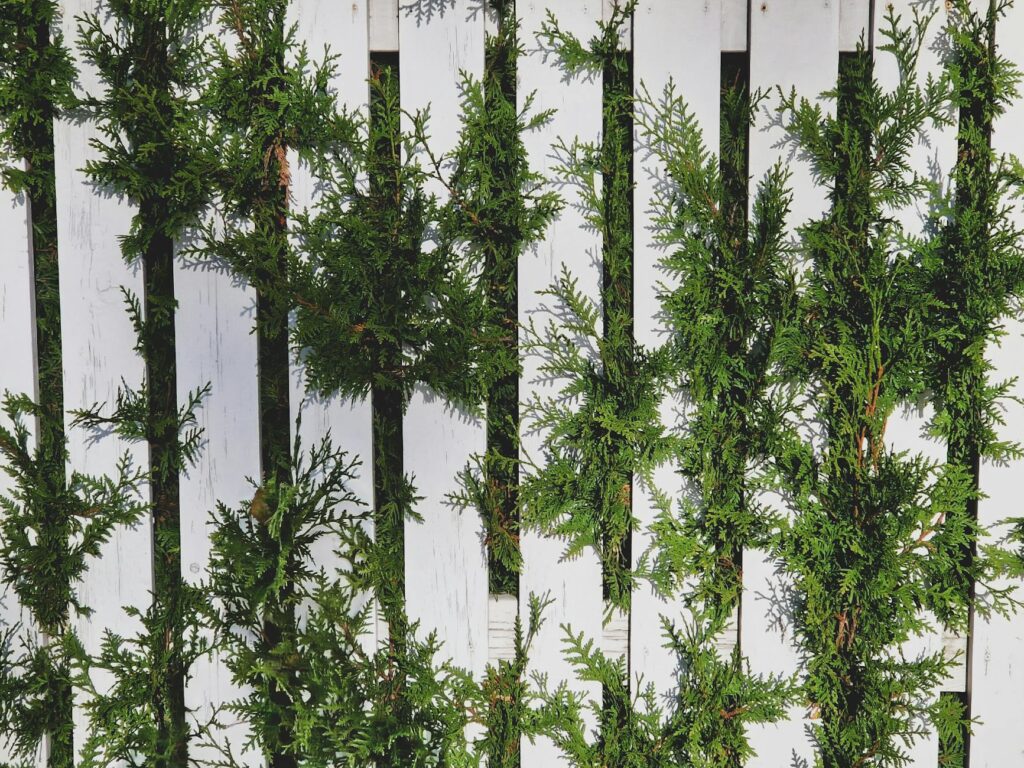
Eastern hemlock is one of the most ecologically valuable trees in the northeastern forest. Its dense evergreen canopy shades streams and keeps water temperatures low enough to support cold-water species. Its year-round foliage provides critical winter cover for songbirds, and its seeds feed red squirrels, crossbills, and other wildlife. In residential settings, mature hemlocks are essentially irreplaceable as privacy screens — fast-growing alternatives like arborvitae or Leyland cypress simply cannot replicate the texture, longevity, or ecological character of a mature hemlock hedge.
In Middletown specifically, hemlocks appear on properties near the wooded ravines that drain toward the Navesink River, on steep terrain around Hartshorne Woods Park, and in the older neighborhoods where decades of naturalized plantings have created genuine forest edges within the township. Losing a mature hemlock hedge doesn’t only affect the property owner — it reshapes the microclimate of the yard, exposing what was shaded and sheltered ground to wind and full sun, often stressing the surrounding understory plants that adapted to grow in the hemlock’s shadow.
The New Jersey DEP Division of Parks and Forestry’s Forest Health program tracks invasive pest threats statewide, and HWA remains one of the top priorities for New Jersey’s hemlock communities. Losing even a few trees in a residential stand can create gaps that accelerate decline in the remaining hemlocks by reducing the canopy shelter they provide one another.
Treatment Options That Work — and When to Use Them
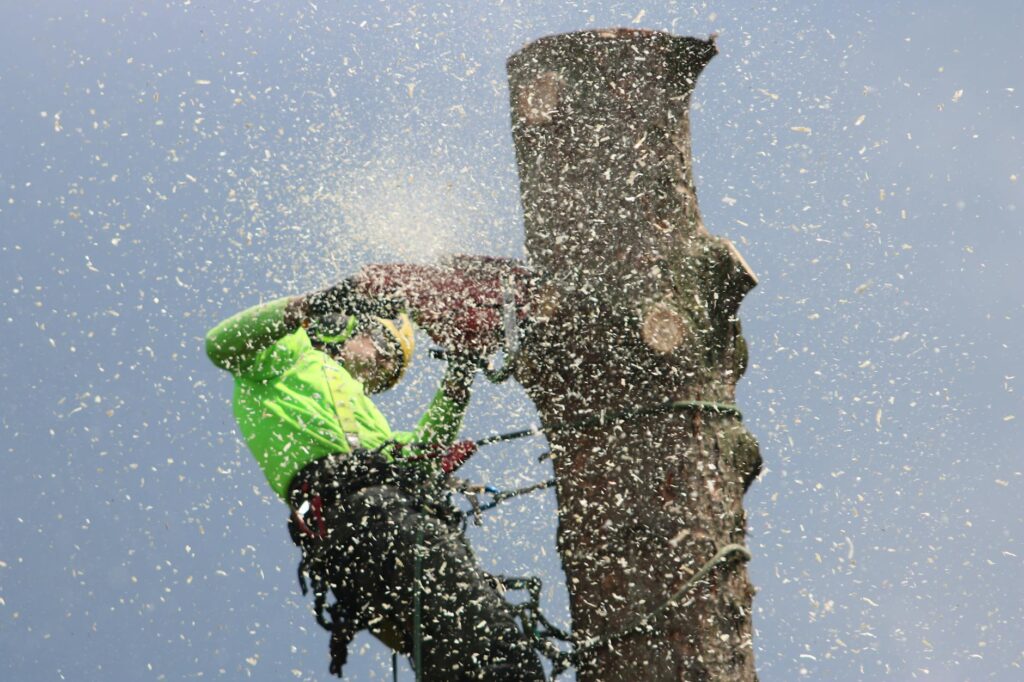
The reassuring news: unlike some other invasive pests we’re dealing with in Monmouth County right now, HWA is highly treatable when caught in time. The key is choosing the right method for your situation and understanding the timing constraints.
Systemic insecticides — imidacloprid or dinotefuran — are the standard approach for established hemlocks. Applied as a soil drench, soil injection, or trunk injection, these systemic products move through the tree’s vascular system to reach the adelgids feeding in the canopy. Imidacloprid treatments applied to soil can provide control for five to seven years from a single application — a significant return on investment for a tree you intend to keep. Dinotefuran acts faster, often within weeks rather than months, and is frequently preferred when a tree is already showing signs of stress and needs rapid intervention. Trunk injection of imidacloprid can show results within the same season it’s applied.
Contact sprays — horticultural oil or insecticidal soap — are effective against exposed crawlers but require thorough coverage of all foliage. That’s practical for small specimen hemlocks or young hedges, but not for a mature 40-foot privacy screen. These options need careful timing to hit the unprotected crawlers before they form their waxy covering, typically between late spring and early fall.
One important caution: if your hemlocks are within 75 feet of a stream, pond, or wetland — a common situation given Middletown’s ravine terrain — soil drenches and injections of imidacloprid carry a groundwater contamination risk. In those situations, trunk injection or a product with a lower aquatic toxicity profile is the appropriate choice. A licensed pesticide applicator can assess your specific conditions and select accordingly.
The Mistakes That Accelerate Hemlock Decline
One of the most counterintuitive things I tell homeowners with HWA-infested hemlocks: do not fertilize them. Research from Rutgers and multiple university extension programs has documented that nitrogen fertilization actively enhances adelgid survival — infested hemlocks growing in fertilized soil support roughly twice as many adelgids as those on unfertilized ground. If you’ve been applying lawn fertilizer near your hemlocks, stop. Their roots are almost certainly extending into that fertilized zone.
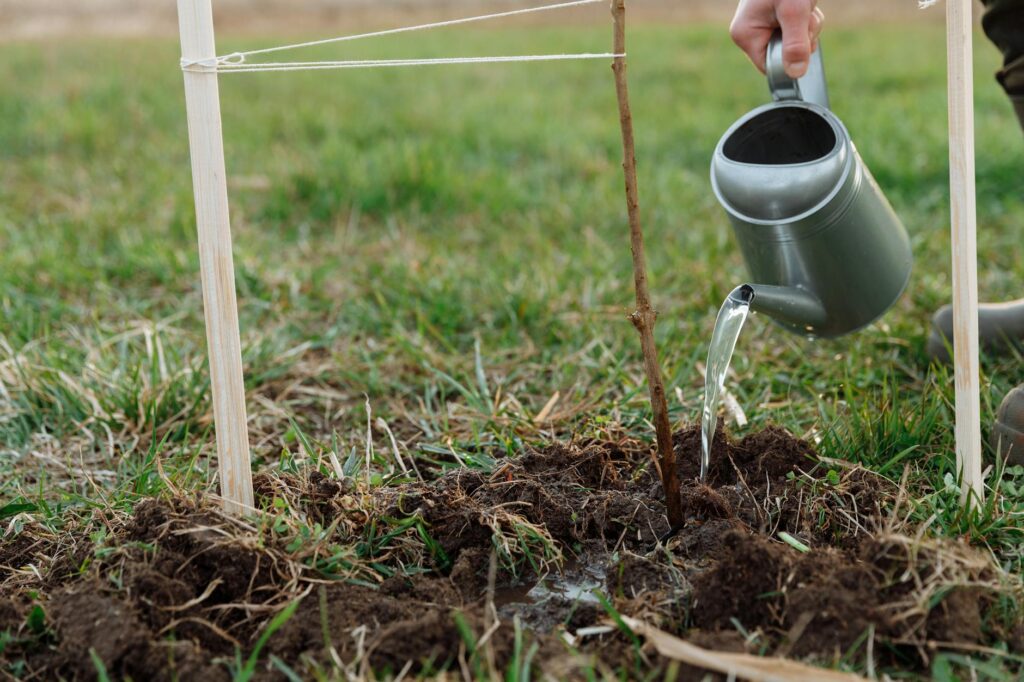
Drought stress is the other major accelerant of decline. Hemlocks evolved in moist, shaded ravines, not the hot, dry conditions of a south-facing yard during a drought year. A drought-stressed hemlock has a reduced capacity to defend against any pest. During dry stretches from June through September, deep, slow watering at the drip line — not at the trunk — helps maintain tree vigor and maximizes the effectiveness of any systemic treatment you’ve applied. A 3-inch layer of wood chip mulch over the root zone, pulled back a few inches from the trunk, retains soil moisture significantly and helps regulate soil temperature.
Perhaps the most consequential mistake is waiting. HWA moves faster than most homeowners expect. A light infestation can become a heavy one within a single growing season, particularly on a tree that is already under some form of stress. The hemlocks I’ve seen die in this area almost always had HWA for several seasons before the homeowner noticed — and by the time the dieback was unmistakable, the tree had passed the realistic recovery threshold. If you suspect HWA, this spring is your window.
Middletown's #1 Tree Expert Company
FREE Inspection & Estimate | Certified Arborists | Trimming, Pruning, Removal, More!
Sponsored
Summary: When to Call a Certified Arborist
Hemlock woolly adelgid is one of those pests that is quietly devastating and yet also one of the most successfully managed when addressed with the right timing and approach. Late April through May — right now — is the prime scouting window for Middletown homeowners. If you have hemlocks on your property, take ten minutes to check the underside of the branch tips for white woolly masses. Finding an infestation early dramatically improves the outcome.
For hemlocks showing any signs of stress or confirmed HWA, the situation calls for an ISA-certified arborist who can assess tree vigor, confirm the pest, and recommend the correct treatment method for your specific conditions. This is especially true if your trees are near a stream or wetland, where treatment choices become technically complex and regulated. Systemic treatments require a licensed pesticide applicator, and choosing the wrong method or application timing can waste money and leave the tree unprotected when it needs help most.
Eastern hemlocks are worth the investment. Once they’re gone from a property or a neighborhood, there’s no realistic substitute for what they provided — visually, ecologically, or functionally. The ones still standing in Middletown deserve a close look this spring before the growing season gets away from you.
Photo credits: Featured image by Sharon Snider on Pexels; Section 1 by Joshua Woroniecki on Pexels; Section 2 by Lauri Poldre on Pexels; Section 3 by Юлия Зяблова on Pexels; Section 4 by Hanno Vesiallik on Pexels; Section 5 by Henk Schuurmans on Pexels; Section 6 by Thirdman on Pexels; Section 7 by 柏林科纳斯 艾伦 on Pexels.