
Middletown's #1 Tree Expert Company
FREE Inspection & Estimate | Certified Arborists | Trimming, Pruning, Removal, More!
Sponsored
The Impulse That Can Backfire in July
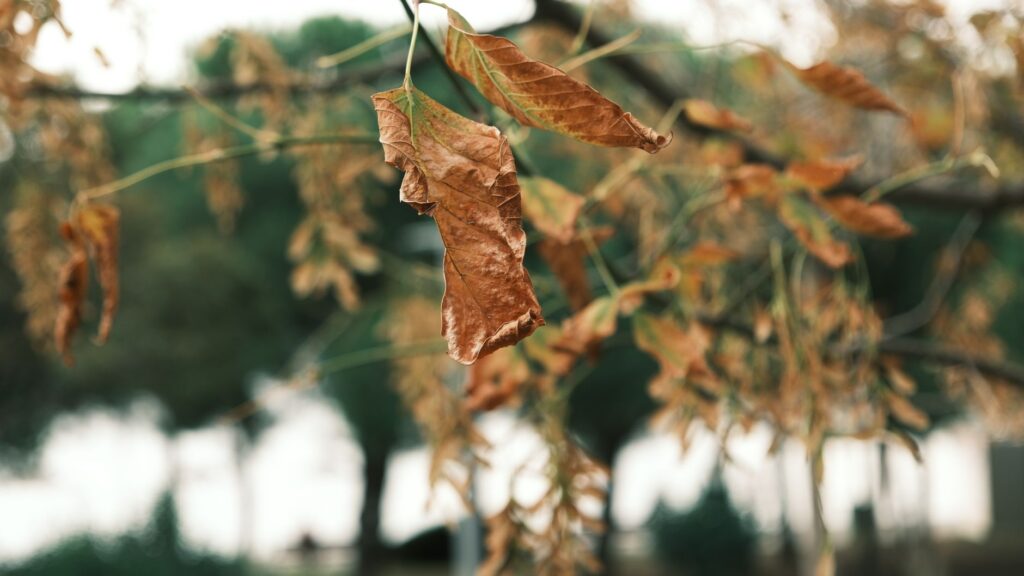
Every July, I see the same thing in Middletown yards: fertilizer spikes hammered into the ground around a tree that looks pale, wilted, or just “off.” The homeowner’s reasoning is sound — the tree looks like it’s struggling, so surely it needs to eat. It’s a caring impulse. It’s also, in most cases, exactly the wrong move.
July in Middletown Township is not a gentle month for trees. Temperatures routinely climb into the low 90s, the clay-loam soils that underlie most of our residential neighborhoods hold heat near the surface, and rainfall becomes unpredictable — sometimes absent for weeks at a stretch. Trees are already working hard just to survive. Throwing fertilizer into that equation doesn’t help them recover. For many species, it actively adds to their stress.
This isn’t an obscure arborist opinion. It’s the consistent guidance from Rutgers NJAES and the International Society of Arboriculture: fertilizing during heat stress, drought, or active summer dormancy carries real risk. Understanding why — and what to do instead — can make a meaningful difference for the trees on your property.
What Fertilization Actually Does to a Tree
Before we talk about timing, it helps to understand what fertilizer actually triggers inside a tree. Most lawn-and-garden fertilizers, and the majority of tree fertilizer spikes sold at hardware stores, are high in nitrogen. Nitrogen is the primary driver of new vegetative growth — it’s what pushes a tree to put out new leaves, extend new shoots, and build new tissue.
That sounds beneficial. In the right season, it is. But growth requires energy, water, and carbohydrates the tree has stored. In spring, a tree has just spent the winter accumulating starch reserves, the soil is moist, and the tree is primed to expand. In July, the situation is almost entirely reversed: the tree has been drawing down its reserves for months, the soil moisture is often marginal, and most species are entering a period of reduced metabolic activity that functions like a partial summer brake — not dormancy in the winter sense, but a deliberate slow-down to conserve resources through the hardest part of the year.
Push a tree to grow new foliage in those conditions and you’re asking it to produce something tender and water-hungry at precisely the moment it can least support it. New growth pushed out by midsummer nitrogen is often pale, soft, and prone to scorch. It’s also attractive to piercing-sucking insects like aphids that prefer young tissue, and it can’t harden off before fall. You’ve essentially tricked the tree into spending reserves it doesn’t have on tissue it can’t defend.
How to Tell If Your Tree Actually Has a Nutrient Problem
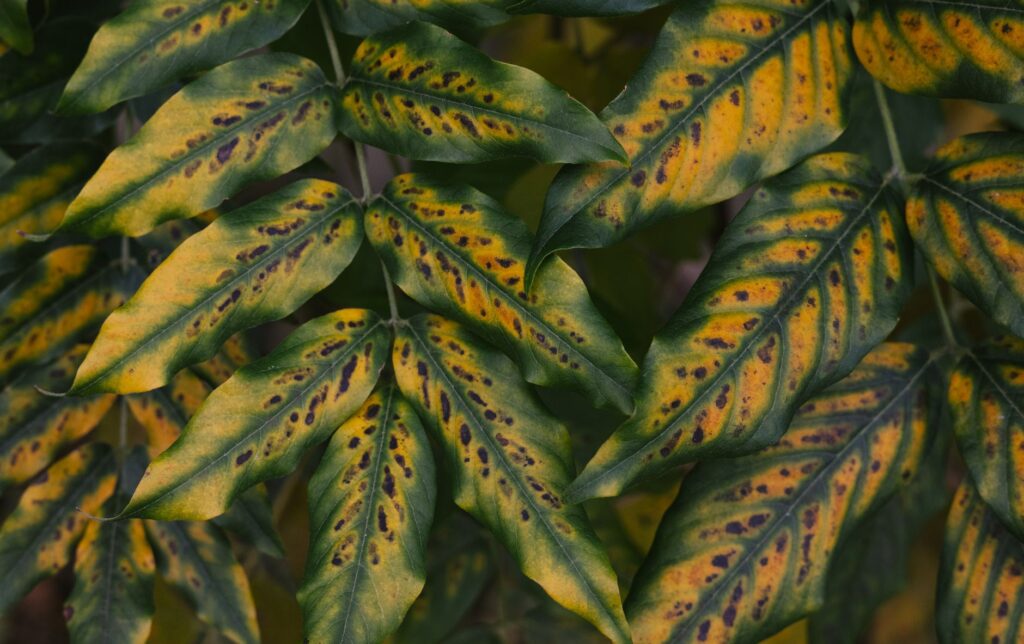
Most Middletown trees that look stressed in July are not suffering from nutrient deficiency. They are suffering from heat, drought, soil compaction, or root zone damage — problems that fertilizer cannot fix and may worsen. Distinguishing between those conditions and an actual deficiency requires looking at specific symptoms, not just a general sense that the tree “looks bad.”
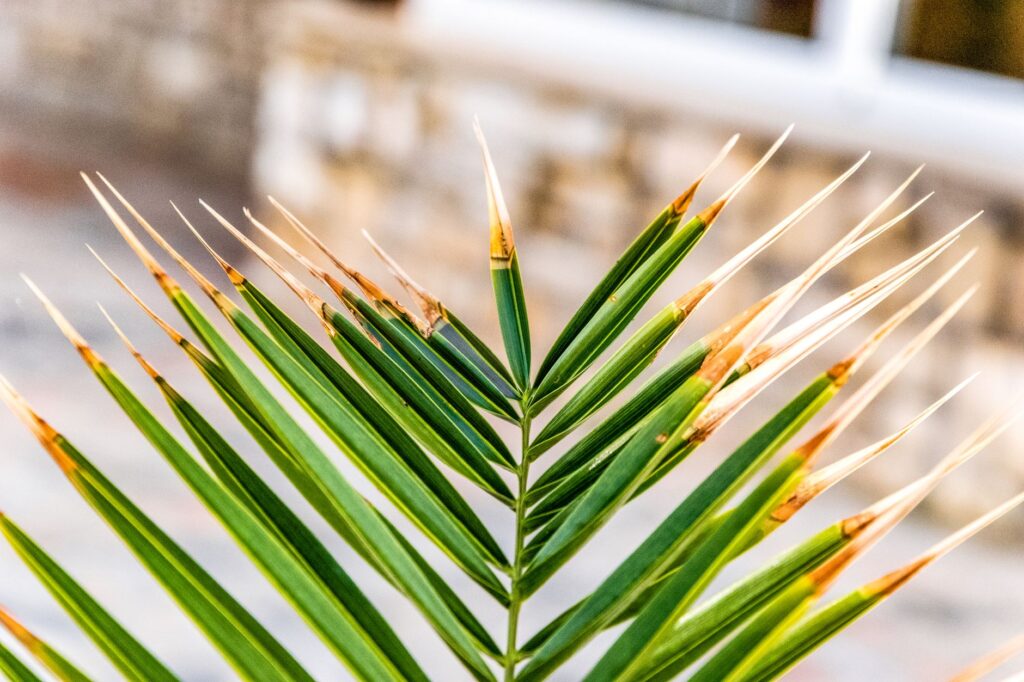
Drought and heat stress show up as leaf curl, early defoliation (the tree deliberately drops leaves to reduce water loss), scorched edges on leaves (sometimes called marginal scorch), and wilting that improves slightly in the cooler morning hours. These symptoms typically appear across much of the canopy at once, not patchwork. Deep watering, not fertilizer, is the correct response.
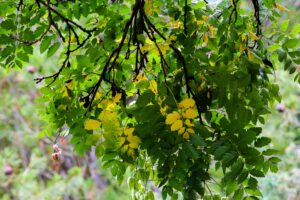
Nutrient deficiencies — particularly iron chlorosis, which is common in Middletown’s more alkaline pockets of soil — show up differently. In iron deficiency, leaves yellow between the veins while the veins themselves stay green (this is called interveinal chlorosis). Nitrogen deficiency tends to cause an older-leaf-first general yellowing that moves up the plant over time. These patterns are meaningful and specific. If you’re seeing them, the right next step is a soil test through the Rutgers Cooperative Extension soil testing lab — not a bag of 10-10-10 from the hardware store. A soil test tells you what’s actually deficient and, just as importantly, what the soil pH is doing to nutrient availability.
The important nuance: even a confirmed nutrient deficiency usually shouldn’t be addressed with a fast-release nitrogen application in July. A certified arborist can recommend timing and form of treatment — often a slow-release or chelated product — that matches the tree’s actual condition.
Middletown's #1 Tree Expert Company
FREE Inspection & Estimate | Certified Arborists | Trimming, Pruning, Removal, More!
Sponsored
Why July Is the Worst Month for Most Tree Fertilizer Applications
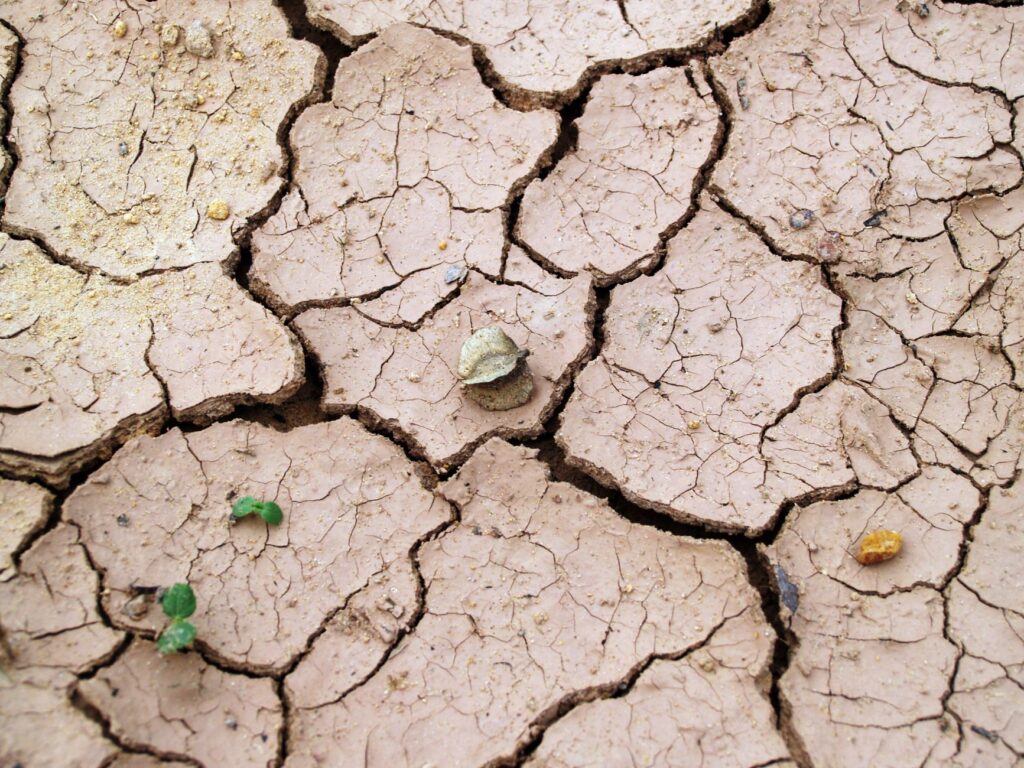
There are a few specific reasons why July creates a particularly unfavorable window for fertilizing most trees in Middletown and across Monmouth County.
First, fast-release nitrogen in dry soil can cause fertilizer burn at the root tips — the same phenomenon that browns lawn edges when someone over-applies granular fertilizer without watering it in. Tree feeder roots are not as tough as people assume. They’re fine, shallow structures that run just beneath the organic layer in the top 12 to 18 inches of soil. In a dry July, those roots are already stressed. Concentrated soluble nitrogen salts drawn into that zone can cause osmotic damage — the roots actually lose moisture to the soil solution rather than absorbing it.
Second, any flush of new growth triggered in late June or July almost certainly won’t harden off before fall. Trees need weeks to lignify (harden) new growth. Soft tissue pushed out in July is still soft when September’s temperature swings arrive. That new growth is prime territory for fall-active fungi, boring insects that prefer young tissue, and early freeze damage.
Third, high-nitrogen summer fertilization can stress the mycorrhizal fungi that colonize most tree roots and dramatically expand their effective water and nutrient absorption range. Research from the USDA Forest Service has documented that excessive nitrogen disrupts mycorrhizal relationships, reducing the network that many established trees depend on for summer water uptake. You may be removing a resource the tree needs precisely when the need is greatest.
When Is the Right Time to Fertilize Trees in Middletown?
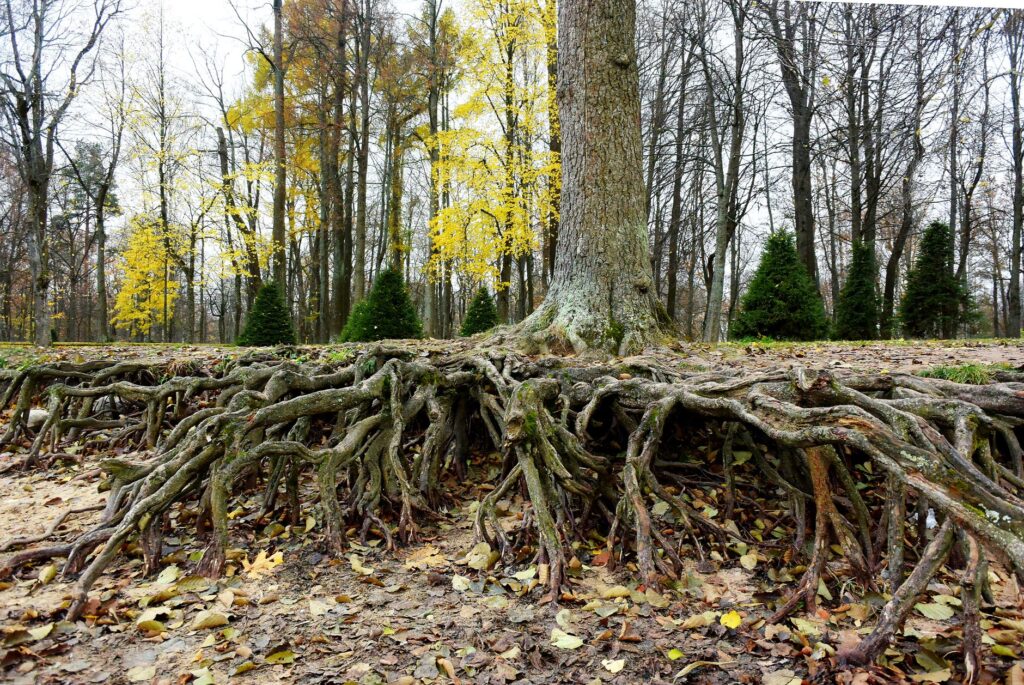
The consensus among arborists and extension specialists is that the optimal window for most tree fertilization in New Jersey runs from late fall to very early spring — specifically, from mid-October through early November, or again in late February to mid-March before budbreak. Both windows have distinct advantages that July simply can’t match.
Late fall fertilization — sometimes called dormant-season feeding — is typically considered the best option for most deciduous trees in our region. By mid-October, trees have largely stopped pushing new growth, but the soil is still warm enough to support root activity and microbial processing of nutrients. Nutrients applied at this time move into the root zone and become available for uptake during the early spring flush, when the tree is most actively growing and can make use of them. Rutgers Cooperative Extension guidance on tree and shrub care consistently recommends this window for most ornamental trees.
Early spring application — just as buds are swelling but before leaves have fully emerged — is a strong second option, particularly if you missed the fall window. At that point, the tree is actively mobilizing stored carbohydrates and water is moving. New growth can harden off normally through the summer. The risk of triggering untimely new growth is low.
Slow-release or controlled-release fertilizer products reduce timing sensitivity somewhat — the nutrients become available gradually over weeks or months rather than in a single soluble pulse. But even slow-release products applied in peak summer heat carry some risk of disrupting root biology, and they’re no substitute for the right-season application that matches how the tree actually works.
What to Do Right Now Instead of Fertilizing
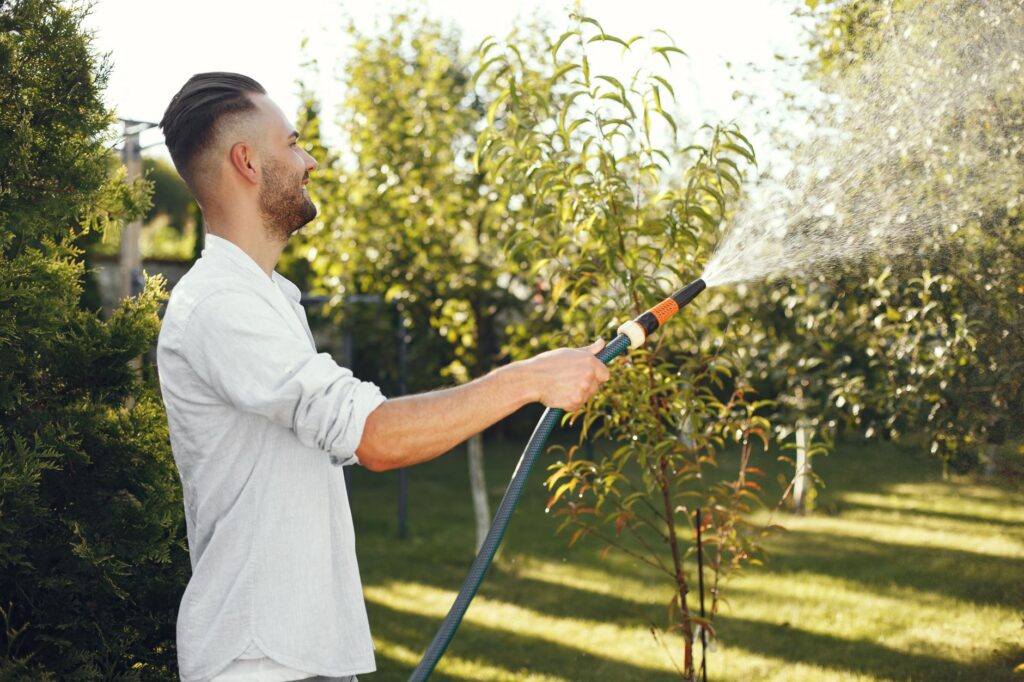
If your trees look stressed this July — pale foliage, early leaf drop, wilting, thin canopy — there’s a short list of things that will actually help, and none of them involve a bag of fertilizer.
The most impactful intervention for most Middletown trees in midsummer heat is deep, infrequent watering. Not a daily sprinkle from an irrigation system — that keeps only the surface layer moist and encourages shallow roots. You want to move water down 12 to 18 inches into the soil where feeder roots live. A slow trickle from a soaker hose or drip line, left running for two to three hours per session, two to three times per week during dry spells, is far more useful than any fertilizer application. For reference, an established tree needs roughly 10 gallons of water per inch of trunk diameter per week during drought conditions.
Check and replenish your mulch layer. A three-inch ring of organic mulch (wood chips, shredded bark) kept away from the trunk flare insulates the root zone from the worst surface heat, reduces evaporation, and moderates soil temperature. In July, soil under a mulch ring can be 10 to 15 degrees cooler than bare or turf-covered soil. That temperature buffer matters enormously for root function. The Monmouth County Park System’s tree planting and care guidance recommends maintaining this mulch ring as a standard practice for all shade trees.
Avoid heavy pruning this month. Removing foliage in July forces the tree to spend energy regenerating — energy it’s currently using to survive the heat. Light dead-branch removal is fine. Major crown work in a drought-stressed tree should wait until fall or late winter.
- Deep watering — 10 gallons/inch trunk diameter/week during dry spells
- Mulch maintenance — 3 inches, cleared from trunk flare, extended to drip line if possible
- Minimize pruning — defer major cuts until October or February
- Leave the root zone alone — no cultivation, tilling, or soil disturbance near the tree
What you’re doing with these steps is reducing stress, not pushing growth. That’s exactly what a tree needs in July.
Middletown's #1 Tree Expert Company
FREE Inspection & Estimate | Certified Arborists | Trimming, Pruning, Removal, More!
Sponsored
When to Call a Certified Arborist About Your Tree's Nutrition
If you’ve been watching a tree decline over multiple seasons — not just looking rough in July, but progressively thinning canopy, repeated dieback, persistent yellowing that doesn’t improve after a wet period — a soil test is a logical first step. The Rutgers Cooperative Extension soil lab can test for major nutrients, pH, and organic matter for a modest fee, and the results will tell you whether a deficiency is actually present or whether the problem lies elsewhere.
A certified arborist can go further: a visual inspection of root flare, soil compaction assessment, and a review of site conditions (pavement, grade changes, irrigation history) often reveals why a tree isn’t thriving in ways that a soil test alone won’t catch. Many cases of apparent nutrient deficiency in Middletown turn out to be rooted in high soil pH locking out iron and manganese, or in compaction and poor drainage that simply prevent roots from functioning normally. You can apply fertilizer every season and never address the underlying problem.
If treatment is warranted, a professional can time it correctly, select the appropriate product and application method (trunk injection, soil application, foliar treatment for certain deficiencies), and monitor the response. That’s a very different approach from hammering a fertilizer spike and hoping for the best in the heat of summer.
Your trees are telling you something when they struggle in July. The message is almost never “feed me.” It’s usually “give me water, give me room, leave the soil alone, and let me get through this the way I’ve gotten through every summer for the past several decades.” A stressed tree that gets the right support through midsummer will reward you in fall with a much better recovery than one that gets pushed to grow when it can’t.
Photo credits: Featured image by Richard REVEL on Pexels; Section 1 by hubbugaye on Pexels; Section 2 by Matej Bizjak on Pexels; Section 3 by Ellie Burgin on Pexels; Section 4 by icon0 com on Pexels; Section 5 by RinaS on Pexels; Section 6 by Gustavo Fring on Pexels; Section 7 by David McBee on Pexels.