
Middletown's #1 Tree Expert Company
FREE Inspection & Estimate | Certified Arborists | Trimming, Pruning, Removal, More!
Sponsored
Every Spring, I Watch Middletown Homeowners Make the Same Mistake
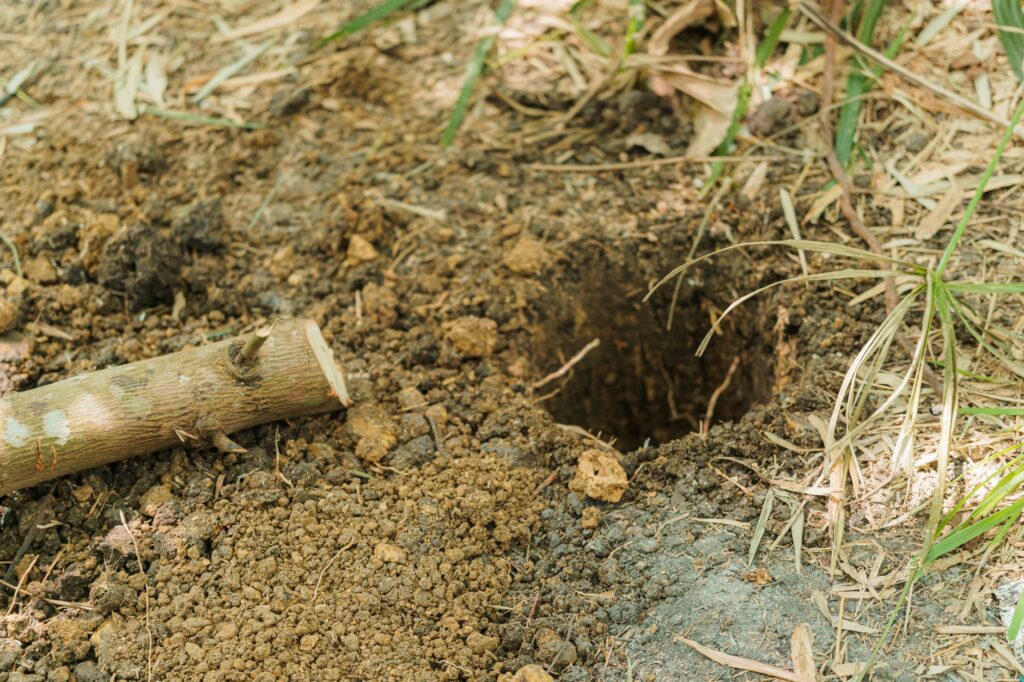
Each spring in Middletown Township, I watch homeowners do almost everything right. They visit a good nursery, choose a healthy tree, dig a careful hole in their backyard, water faithfully through the summer, and wait for their investment to take hold. Three years later, they call me because the tree is thin, growing slowly, and looking wrong at the base. Seven years later, in too many cases, the tree is gone.
The culprit, almost always, is planting depth. More specifically: the tree went in the ground two, three, or four inches too deep on the day it was planted. It didn’t show up right away — it never does — but the damage began immediately and compounded silently through every subsequent season.
This is the single most preventable tree failure I encounter in Monmouth County. It costs homeowners hundreds of dollars in replacement trees and years of waiting for a canopy that never fully develops. And it is almost never the homeowner’s fault in the traditional sense: they followed the directions on the tag, they dug to the right depth in the pot, and they did everything the internet said to do. The problem is that the advice they followed was incomplete.
If you’re planting a new tree this month — or if you have a young tree that’s been underperforming since it went in — this is the information that changes the outcome.
What the Root Flare Is — and Why It Must Stay Above Ground

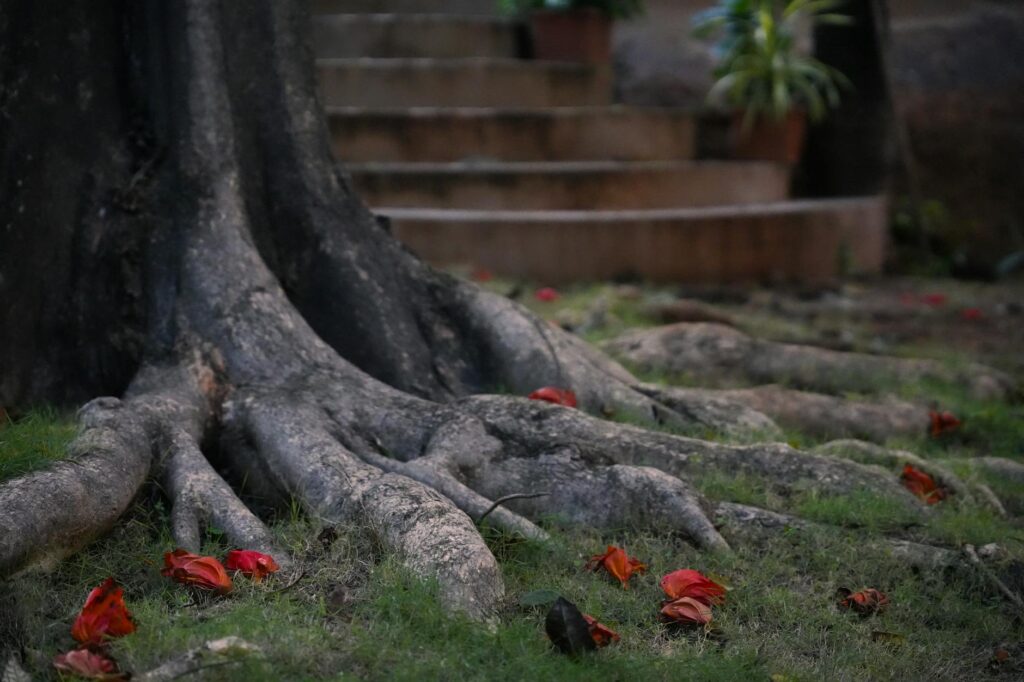
The root flare — also called the root collar — is the zone at the very base of the trunk where the stem transitions into the root system. On most trees, it’s visible as a gentle widening or buttressing, a subtle flare outward before the trunk meets the ground. It’s not just structural anatomy. It’s the most biologically critical zone on the whole tree.
The bark at the root flare is specialized for gas exchange: it’s permeable in a way that allows oxygen to reach the vascular tissue. This works when the flare is exposed to air, as nature intends. When it’s buried under soil or piled mulch, oxygen exchange stops, anaerobic conditions develop in the bark tissue, and microbial decay begins. The tree doesn’t fail immediately, but the clock starts the moment the flare goes under.
In a natural forest, the root flare is always at or just above the soil surface. Trees never bury themselves during growth. The entire biological system assumes constant air exposure at the base. According to the International Society of Arboriculture’s planting guide, the root flare should be visible at or just above the finished soil grade after planting — not an inch or two below it, even temporarily. This applies to every species: white oaks (Quercus alba), red maples (Acer rubrum), sweetgums (Liquidambar styraciflua), dogwoods (Cornus florida), and every ornamental planted in a Middletown front yard.
Why the Soil Line in the Pot Isn't What You Think

Here is the part that trips up even careful homeowners: the visible soil line in a nursery container is not the root flare. In many cases, it’s nowhere near it.
Container-grown trees are often potted deep during production — sometimes intentionally for stability, sometimes through a series of repottings where fresh media gets added on top. Balled-and-burlapped trees accumulate excess soil in the burlap wrap during harvest. Over multiple seasons in nursery blocks, potting media settles and more gets added. By the time a tree reaches a garden center or big-box store, there may be two to four inches of nursery soil layered on top of the actual root flare. The tag tells you nothing about this.
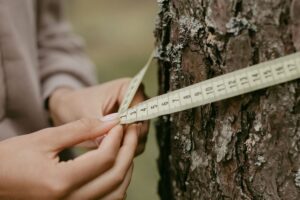
Before you dig your hole, find the root flare in the container. Set the tree on a hard surface and use a hand trowel or your fingers to probe gently downward through the potting mix at the base of the trunk until you feel or see the point where the trunk starts to visibly widen. That point is the root flare. Measure the distance from the root flare down to the bottom of the root ball. That measurement — not the depth of the container — tells you how deep your planting hole needs to be.
I’ve found root flares buried under three inches of potting mix in perfectly healthy-looking container trees at reputable nurseries. Nobody is being negligent; it’s an artifact of how trees are produced and handled commercially. As the person doing the planting, you are the last line of defense.
Middletown's #1 Tree Expert Company
FREE Inspection & Estimate | Certified Arborists | Trimming, Pruning, Removal, More!
Sponsored
What Deep Planting Does to a Tree Over Time
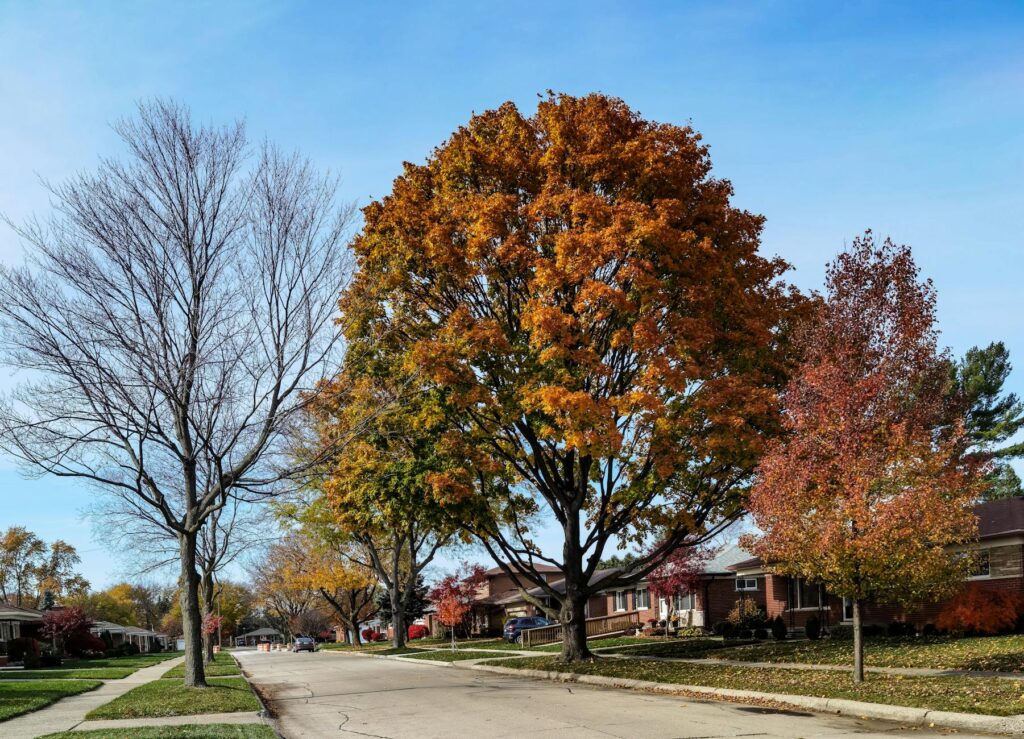
The failure sequence is slow enough to be genuinely deceptive. In the first year, the tree may look fine — it’s drawing on energy stored in the root ball, and the buried bark hasn’t fully deteriorated yet. In year two, growth slows. The canopy may stay slightly thinner than expected, and spring leafout may lag a week behind comparable trees. By year three or four, the decline is hard to ignore: sparse foliage, smaller-than-normal leaves, a flat growth rate.
Underground, several things are happening simultaneously. The buried bark at the root flare is decomposing in the consistently moist, oxygen-depleted soil. Fine feeder roots in the suffocated zone are dying back. And girdling roots — roots that circle the trunk in search of oxygen, rather than spreading outward — begin to form and thicken. These girdling roots gradually constrict the vascular tissue that moves water and nutrients between the root system and the canopy. It’s a slow strangulation that accelerates year after year. (This is distinct from the girdling root problem described in other contexts, though the mechanism is the same: roots that should be spreading instead start wrapping.)
By year six or seven, the tree is often beyond meaningful intervention. Homeowners routinely assume a pest or a disease is the cause, and they’re not entirely wrong — a stressed, deep-planted tree is far more susceptible to secondary pathogens. But the root cause is a planting decision made years earlier. Rutgers Cooperative Extension identifies improper planting depth as one of the most common causes of long-term tree decline in landscape settings, and one of the most frequently missed during diagnosis precisely because of this time lag.
Why Middletown's Soils Make the Problem Worse
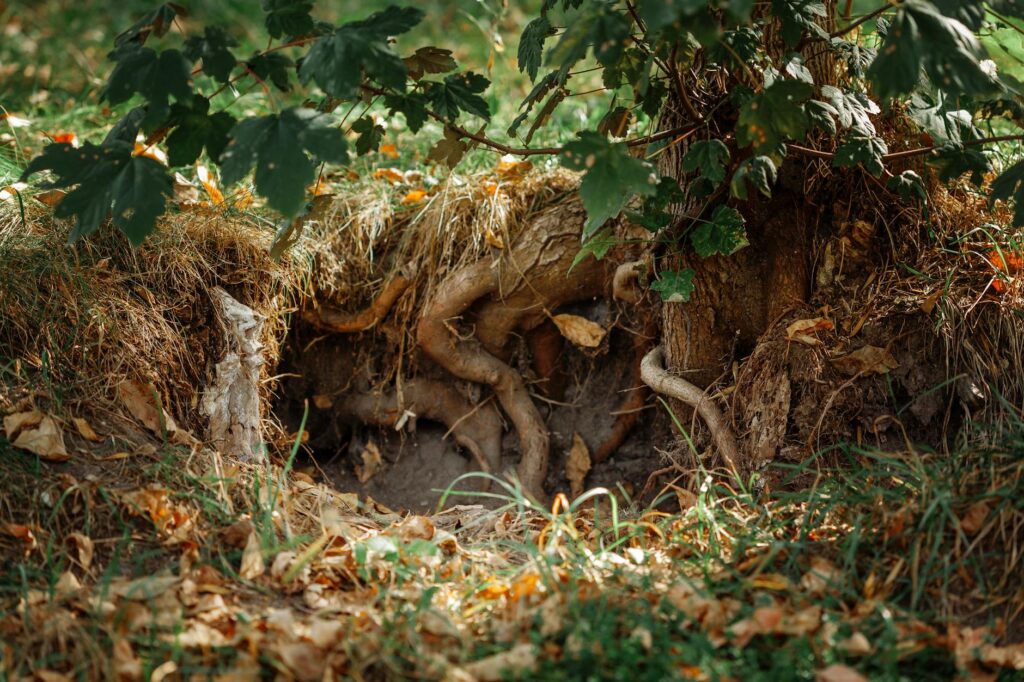
Middletown Township’s soils are predominantly clay-loam and silt-loam, particularly in the inland neighborhoods away from the Sandy Hook shoreline. These soils hold moisture far longer than the sandy coastal soils found in southern Monmouth County. In areas near Port Monmouth, Keansburg, and the lower Raritan Bay watershed, poorly draining soils are especially common — in some spots, water stands in the planting zone for days after a heavy rain.
In heavy, slow-draining soil, a buried root flare stays perpetually moist. The anaerobic conditions that cause bark decay and feeder root suffocation are essentially permanent. A tree that might survive being planted an inch too deep in well-draining sandy loam will die from the same error in Middletown clay. The margin for error is much smaller here than in many other parts of New Jersey.
Soil settlement compounds this further. When you backfill a planting hole — even with native soil from the same hole — it compresses over the first growing season. A tree that was borderline on depth at planting may be measurably deeper by the following spring. This is why I recommend setting the root flare a half-inch to an inch above the surrounding grade when you plant: that allowance accounts for settlement and gives the flare a fighting chance of staying at the correct level through the first few seasons.
Construction activity in Middletown’s expanding residential neighborhoods adds another layer of risk. Contractors routinely pile soil against existing trees during grading, foundation work, and patio installation. A tree that was correctly planted can have its root flare effectively buried years later by a two-inch grade change. USDA Forest Service urban forestry research has documented that grade changes of even a few inches near the root zone can cause multi-year decline, for exactly the same physiological reasons as deep planting.
How to Get Planting Depth Right Every Time
Once you understand what you’re solving for, the mechanics are straightforward. Here’s the process I walk homeowners through:
- Find the root flare before you dig anything. Probe down through the nursery potting mix to the true root flare. Measure from that point to the bottom of the root ball — this is your target hole depth.
- Dig wide, not deep. The hole should be two to three times wider than the root ball but no deeper than that measurement. This wide, shallow shape encourages the lateral root spread that young trees depend on for establishment.
- Set the root flare slightly high. Place the tree in the hole so the root flare sits a half-inch to an inch above the surrounding grade, accounting for settlement.
- Backfill with native soil only. Don’t amend the backfill heavily with compost or topsoil. Amended backfill creates a well-draining pocket surrounded by dense native soil — roots circle inside the amended zone rather than spreading outward, producing the same girdling effect you were trying to avoid.
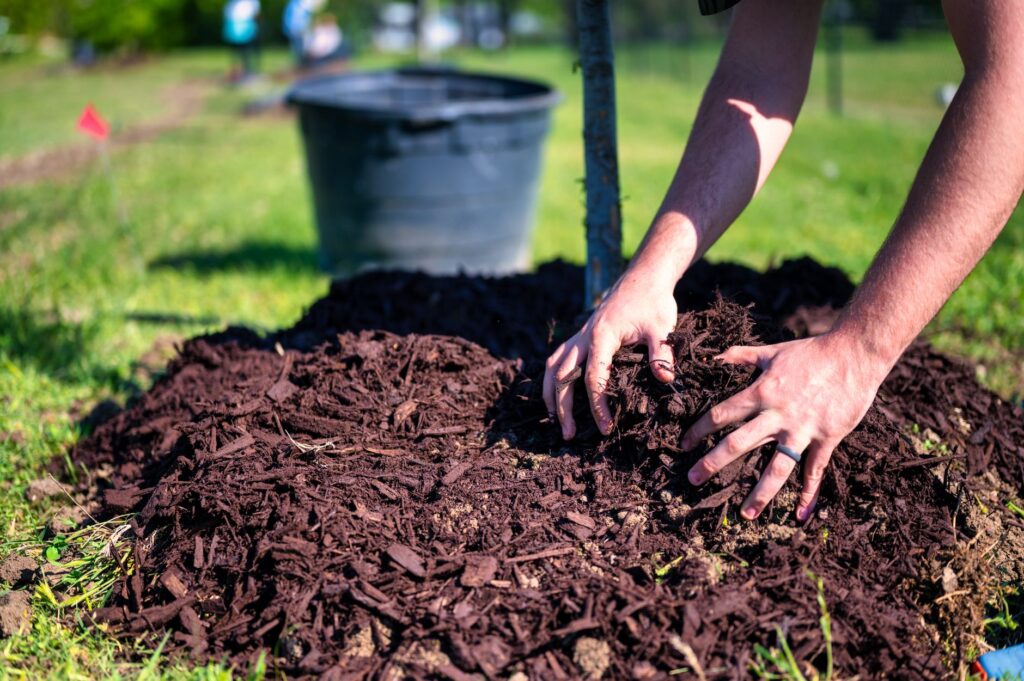
- Water deeply, then mulch correctly. Apply three to four inches of wood chip mulch in a wide ring extending as far toward the drip line as practical. Keep mulch completely clear of the trunk for at least four to six inches in all directions.
That last point bears emphasis. Mulch piled against a trunk — the classic volcano shape — effectively buries the root flare with organic material that holds moisture year-round. It mimics deep planting almost exactly: constant bark moisture, limited gas exchange, accelerated decay. The mulch ring should look like a donut, not a volcano, with the trunk clearly visible above bare soil at the center.
For balled-and-burlapped trees, remove as much of the burlap, wire basket, and excess soil from the top of the root ball as you can once the tree is positioned in the hole. Burlap may decompose eventually, but wire baskets can constrict roots for decades if left in place at the surface.
Middletown's #1 Tree Expert Company
FREE Inspection & Estimate | Certified Arborists | Trimming, Pruning, Removal, More!
Sponsored
When to Call a Certified Arborist

If you’ve already planted a tree and are wondering whether the depth is right, check the base. Can you see a root flare? If the trunk runs in a straight vertical line straight into the ground like a telephone pole, with no visible widening before it disappears into the soil, it’s almost certainly planted too deep. The earlier you catch it, the more options you have.
Caught in the first year or two, many deep-planted trees can be corrected by carefully removing excess soil and exposing the flare — a process a homeowner can often do by hand with a trowel, working gently outward from the trunk. If the tree has been in the ground for three or more years, girdling roots may have already formed, and the work becomes more complex. An arborist can use an air spade — a tool that uses compressed air to excavate soil without damaging roots — to assess the flare zone and remove girdling roots before they cause permanent vascular damage.
If you’re planting a larger specimen — a two-inch caliper tree or a significant balled-and-burlapped tree — it’s worth having a certified arborist or trained nursery professional guide the installation. A five-minute consult before the hole is dug is far less expensive than removing and replacing a tree that failed five years later because the depth was wrong from day one.
For trees already showing decline — thin canopy, slow growth, flat bark at the base, or small leaves — an arborist assessment can often determine whether planting depth is the culprit or whether something else is at work. Many of these trees can still be stabilized if the underlying problem is caught before the vascular system is too compromised. The ISA’s arborist locator can help you find a credentialed professional serving Middletown and Monmouth County. When in doubt, a set of trained eyes at the base of the tree is the best investment you can make.
Photo credits: Featured image by Tapas S on Pexels; Section 1 by Nothing Ahead on Pexels; Section 2 by Plato Terentev on Pexels; Section 3 by www.kaboompics.com on Pexels; Section 4 by Sarowar Hussain on Pexels; Section 5 by Julia Filirovska on Pexels; Section 6 by Alfo Medeiros on Pexels; Section 7 by Thirdman on Pexels.